CIA's Secret War Through Modern Art
- The CIA created the Congress for Cultural Freedom in 1950, which covertly funded exhibitions, magazines, and cultural events across 35 countries for 17 years to counter Soviet
- MoMA fulfilled 38 wartime government contracts and was later used as a de facto government proxy, with the CIA helping finance its international exhibitions during the Cold War.
- A 1946 State Department touring exhibition of American modern art — including works by Georgia O'Keeffe — was recalled in 1947 after domestic public and congressional backlash,
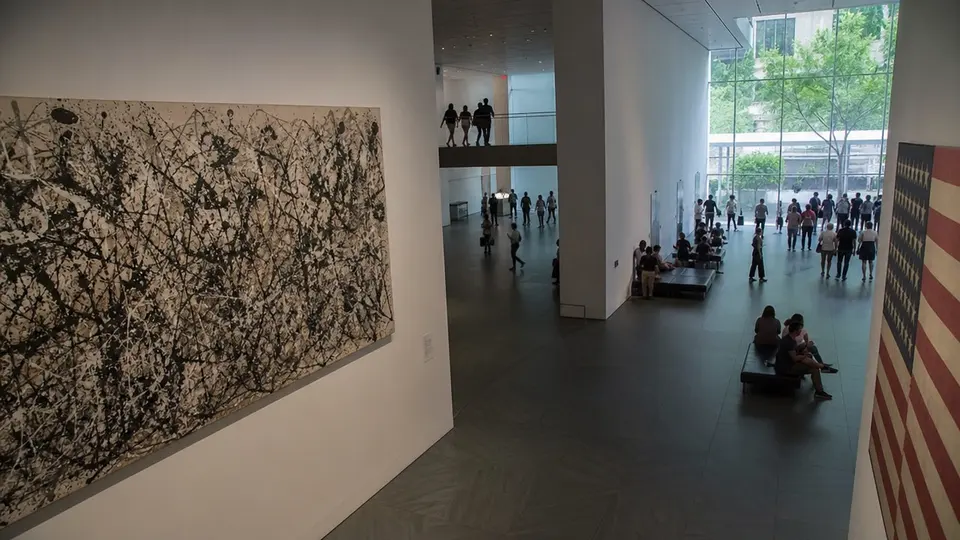
For nearly two decades during the Cold War, the United States government — through the CIA and closely aligned institutions — covertly wielded modern art as an instrument of ideological warfare, funding exhibitions, cultural magazines, and international festivals in a coordinated effort to counter Soviet propaganda and win over the European intellectual left.
From wartime propaganda to covert cultural policy
The entanglement of American modern art with state power predates the CIA itself. During the Second World War, the Museum of Modern Art fulfilled 38 government contracts for cultural materials and mounted 19 exhibitions of contemporary American painting across Latin America under the direction of Nelson Rockefeller, who simultaneously served as President of MoMA and as Franklin D. Roosevelt's Coordinator of Inter-American Affairs. When the war ended, Rockefeller's Inter-American Affairs staffers moved seamlessly into MoMA's international exhibition programme: René d'Harnoncourt became the museum's vice president in charge of foreign activities, and Porter McCray became director of its International Program — the latter taking a leave of absence in 1951 to work on the Marshall Plan.
The State Department's failed experiment
In 1946, the State Department spent $49,000 acquiring 79 paintings — including works by Georgia O'Keeffe and Jacob Lawrence — for a travelling exhibition entitled Advancing American Art. The show received positive reviews from Paris to Port-au-Prince, but was recalled in 1947 after a domestic backlash. Look magazine questioned why tax dollars were funding what it considered bewildering canvases. President Harry Truman, viewing Yasuo Kuniyoshi's Circus Girl Resting, reportedly remarked: "If this is art, I'm a Hottentot." He separately considered modern art "merely the vaporings of half-baked lazy people." In Congress, Republican representatives John Taber of New York and Fred Busbey of Illinois alleged that some participating artists harboured Communist sympathies or had engaged in un-American activities. The entire collection was eventually sold for a total of $5,544.
The episode made one strategic lesson plain: Congress could not reliably be induced to fund cultural diplomacy of this kind. Thomas W. Braden, who served as MoMA's executive secretary from 1948 to 1949 before joining the CIA in 1950 to supervise its cultural activities, later wrote that the prospect of congressional approval for such projects was "about as likely as the John Birch Society's approving Medicare."
Enter the CIA
The CIA was formally established in 1947, growing out of the wartime Office of Strategic Services. Both John Hay Whitney — a former MoMA president — and Braden had been OSS members, as had figures including the poet Archibald MacLeish, the historian Arthur M. Schlesinger Jr., and the Hollywood director John Ford. By the time the Agency was codified, the overlap between America's cultural elite and its intelligence apparatus was already well established.
In 1950, the CIA created the Congress for Cultural Freedom (CCF), headquartered in Paris. Though it presented itself publicly as an autonomous association of artists, musicians, and writers, the CCF was in practice a CIA-funded operation intended, in Braden's later description, to "propagate the virtues of western democratic culture." At its peak, the CCF had offices in 35 countries, employed dozens of staff, published more than 20 prestige magazines, held art exhibitions, ran a news and features service, organised international conferences, and awarded prizes to musicians and artists. It operated for 17 years.
Paris was chosen as the CCF's base deliberately: it was the cultural capital of Europe, and the organisation's primary audience was the European intellectual left — people who, as Braden acknowledged in a 1967 article, were "the only people who gave a damn about fighting Communism" in much of 1950s Europe, yet whom many Americans regarded as little better than Communists themselves. Braden described the CIA's cultural bid as "the battle for Picasso's mind," waged through Jackson Pollock's art.
MoMA as government proxy
The CIA also helped finance MoMA's international exhibitions directly. In 1954, MoMA assumed control of the United States Pavilion at the Venice Biennale from the State Department — becoming, notably, the only privately owned national pavilion at the show — allowing American modern art to be exhibited abroad without recourse to public appropriation. That same year, President Dwight D. Eisenhower, speaking at MoMA's twenty-fifth anniversary, called modern art a "Pillar of Liberty," contrasting it explicitly with the condition of artists under tyranny.
The CCF and MoMA co-operated to stage the 1952 Masterpieces of the Twentieth Century festival in Paris, drawing on MoMA's collection. Curator James Johnson Sweeney took care to note that the works displayed "could not have been created by such totalitarian regimes as Nazi Germany or present-day Soviet Russia." MoMA's August Heckscher declared in 1954 that the museum's work was "related to the central struggle of the age — the struggle of freedom against tyranny."
The CIA also bankrolled the Partisan Review, the organ of the American non-Communist left, whose editor was the art critic Clement Greenberg — the foremost champion of abstract expressionism in post-war New York and, as such, the tastemaker whose judgements shaped the very movement being deployed as a geopolitical instrument.
The paradox at the heart of the project
The central irony of the CIA's cultural strategy was that its chosen weapon — abstract expressionism, championed by artists who openly disdained orthodoxy and were frequently unpopular with the American public — was effective precisely because it was not state-sanctioned aesthetic. Truman privately loathed it. Rockefeller nevertheless called it "Free Enterprise Painting." The New Yorker, with some acuity, described its political function as "The Unpopular Front." Its very existence, the argument ran, demonstrated that American artists were free to create, whether their compatriots approved or not — a freedom Soviet Socialist Realism could not replicate. The strategy depended, in other words, on the state covertly promoting art that the state's own leaders considered worthless.