Supreme Court Allows Trump Mail Vote Restrictions to Proceed
- The Supreme Court's conservative majority lifted one of two injunctions blocking Trump's executive order restricting mail-in voting, but a second injunction preventing USPS from
- Justice Ketanji Brown Jackson dissented, warning the ruling injects chaos into the midterm elections, while NAACP president Derrick Johnson condemned it as an attempt to suppress
- California governor Gavin Newsom pledged to sue the Trump administration again and backed two proposed state laws that would make interference with mail ballot delivery a felony
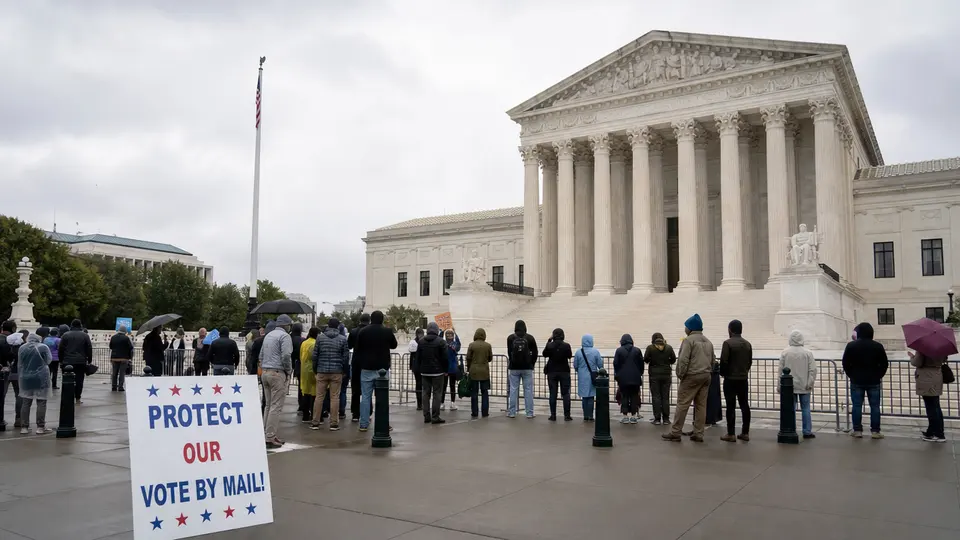
The United States Supreme Court has granted the Trump administration's request to lift a lower court order that had blocked it from implementing an executive order restricting mail-in voting, in a decision that the NAACP has condemned as an assault on democratic participation ahead of the November midterm elections.
The ruling and what it permits
The court's six Republican-appointed justices issued an unsigned opinion lifting one of two lower-court injunctions that had prevented the administration from acting on a March 2026 executive order. That order directs federal officials to compile lists of eligible voters and instructs the US Postal Service (USPS) to deliver mail ballots only to individuals appearing on those lists. The court's three liberal justices dissented. Crucially, a second injunction — which specifically prevents the USPS from implementing a new rule that would allow it to refuse to deliver ballots from voters not on a federally approved list — was not addressed by Monday's ruling and remains in force.
Legal analyst Rick Hasen, a law professor at UCLA, noted on his Election Law Blog that the court's opinion found the 23 states and Washington DC that originally sued had filed prematurely, before the USPS had formally proposed its new rule. Hasen described it as "just weird" that the court issued its ruling given that the USPS's final rule was posted online late on Friday and is set to take effect this week — meaning the states had, in effect, filed suit at nearly the right moment.
Dissent from the bench
Justice Ketanji Brown Jackson issued what she described as a pointed dissent, warning that the decision "needlessly injects chaos and uncertainty into the upcoming midterm elections". She argued that allowing the administration to proceed "contributes to pre-election chaos instead of quashing it", and emphasised that the Constitution "expressly delegates the power to conduct federal elections to the States". In her view, Trump's 31 March executive order "attempted to alter this longstanding, constitutionally assigned structure".
NAACP and California respond
The NAACP, which filed its own separate suit against the Trump administration in April to block the executive order, swiftly condemned the ruling. The organisation's president, Derrick Johnson, said in a statement: "Let this ruling be a reminder that democracy is never, ever, guaranteed. We have to fight for it, we have to fight to keep it, and we have to protect the rights we do have within it." Johnson alleged that Trump's order "has nothing to do with election integrity" and "has everything to do with maintaining power at all costs."
California's governor, Gavin Newsom, announced that the state would sue the Trump administration again. "California will be suing AGAIN to block these Orwellian rules from being implemented," he wrote on social media. Newsom also highlighted two proposed state laws that would create three new felonies under California law — punishable by up to four years in prison — including a prohibition on seizing ballots, election records, or certified voting technology before election results are certified.
What remains unresolved
The Supreme Court's ruling leaves several questions open. The second USPS injunction — potentially the more operationally significant of the two — has not yet been ruled upon and continues to block the postal service from refusing ballot deliveries. Further legal challenges are anticipated, and with some states due to begin sending mail ballots to voters within weeks, the courts may be called upon to rule again before the midterms. The administration's broader efforts to reshape voting procedures ahead of November are likely to face sustained judicial scrutiny, making this one of several consequential voting-rights cases now before the justices.
More in Crime & Justice
→ Crime & Justice
Eleven Cases Cloud Spain's Autumn
Crime & Justice
Eleven Cases Cloud Spain's Autumn
 Crime & Justice
Copacabana Lynching Shocks Brazil
Crime & Justice
Lockerbie Trial Postponed Again
Crime & Justice
Copacabana Lynching Shocks Brazil
Crime & Justice
Lockerbie Trial Postponed Again
 Crime & Justice
Third Leipzig Drone Carried Hexogen
Crime & Justice
Third Leipzig Drone Carried Hexogen
 Crime & Justice
Family Stranded 26 Days in Ceuta Estate
Crime & Justice
Family Stranded 26 Days in Ceuta Estate
 Crime & Justice
Post Offices Used to Launder Dirty Cash
Crime & Justice
Post Offices Used to Launder Dirty Cash