Rome Explores Ancient Underground as Climate Shelters
- Rome's city government and ISPRA are at a preliminary stage of assessing whether ancient underground cavities — including catacombs and quarries — could serve as free public
- Structural instability, high humidity and radon gas emissions are identified obstacles, though ISPRA geologist Francesco La Vigna argues all are technically solvable through
- Rome has launched a €50m Heat Plan over five years and city data show temperatures have risen nearly two degrees in four years against the 1990–2020 average, with tropical nights
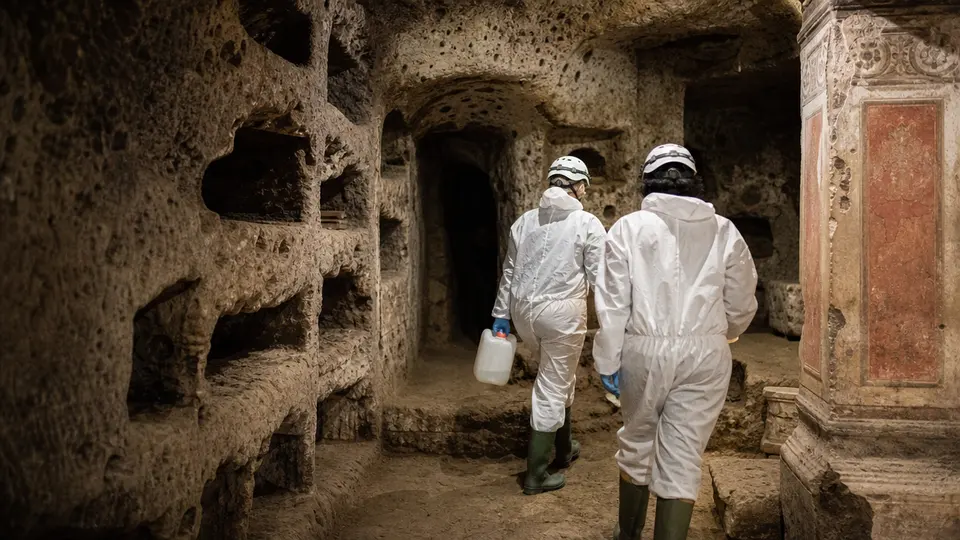
Rome is examining whether the vast network of tunnels, catacombs, quarries and ancient galleries beneath its streets could one day serve as public refuges from extreme summer heat — a proposal that remains at a very early stage but reflects the growing urgency of climate adaptation in one of Europe's most historically layered cities.
A city beneath the city
Centuries of excavation have left Rome with an extensive subterranean world spanning more than 100 square kilometres of mapped cavities, according to surveys conducted by the Higher Institute for Environmental Protection and Research (ISPRA) in partnership with the National Research Council (CNR) and the University of Tuscia. The geology of the city — rich in volcanic materials such as tuff and pozzolana, which are relatively easy to excavate — accounts in part for the sheer density of these spaces. Their historical uses have ranged from mithraea where ancient Romans worshipped the god Mithras and catacombs serving as Christian burial grounds, to railway tunnels and Second World War air-raid shelters.
The scientific case for using these spaces rests on a well-established thermal property. Francesco La Vigna, an ISPRA geologist and chair of the Urban Geology Expert Group at EuroGeoSurveys, explains that from roughly 3.5 metres below the surface, ground temperatures stabilise and no longer track the sharp swings experienced above ground. In Rome, he says, underground cavities typically hold between 10°C and 17°C throughout the year. During summer measurements when surface temperatures exceeded 37°C, the cavities recorded barely 16°C.
Safety, humidity, and radon
The idea faces practical obstacles. Many of Rome's ancient cavities have been abandoned for decades or centuries, raising concerns about structural integrity, high humidity, and the potential emission of radon gas from volcanic rock — a hazard with prolonged exposure. La Vigna argues, however, that none of these problems is beyond resolution. Structural consolidation, he says, is technically feasible and less costly than constructing new underground spaces from scratch, while ventilation systems can address both humidity and gas accumulation. He proposes beginning with the largest, best-preserved sites or those already open to visitors, such as certain archaeological locations.
Rome's city government has set two non-negotiable conditions for any such use: safety, including adequate air renewal, and free public access. Edoardo Zanchini, director of the City Hall's Climate Change Office, confirmed that any underground shelters would join Rome's existing network of 178 indoor climate shelter sites — covering libraries, museums, civic centres and senior centres — and more than 400 outdoor spaces, predominantly parks and gardens.
A €50m Heat Plan and rising temperatures
The underground proposal sits within a broader municipal response to worsening summers. This year Rome unveiled its first formal Heat Plan, backed by a €50 million investment over five years. The plan encompasses climate shelters, free potable water points, free film screenings during the hottest hours, and larger interventions to increase shade, vegetation and permeable surfaces across the city. The impetus is clear: city data indicate that temperatures in Rome have risen by nearly two degrees over the past four years relative to the 1990–2020 average, and the number of tropical nights — when temperatures remain above 20°C — has tripled over the same period.
The broader Italian picture this summer has been stark. An almost uninterrupted succession of heatwaves pushed temperatures above 40°C in parts of the south, including Sicily, Calabria, Campania and Apulia. In early August, all 27 cities covered by the national heat monitoring system of the Ministry of Health were simultaneously on red alert, the highest level of warning. Extreme heat has tightened its grip across much of the continent, and the consequences of European heatwaves have become visible from space.
A European context
The impetus for exploring urban subsoil emerged partly at a European level, within EuroGeoSurveys' urban geology group, which La Vigna currently chairs. The group aims to identify how subsurface characteristics can be deployed in climate adaptation across member cities. Precedents exist in colder climates: Toronto and Montreal operate underground networks that protect residents from extreme winter cold, and Helsinki has developed a dedicated plan for regulating the uses of its subsoil. In the Mediterranean, the challenge is increasingly the opposite.
La Vigna suggests Rome's experience could provide a transferable model for making use of underground heritage that is currently largely inaccessible. Zanchini echoes that view, noting that Rome exchanges ideas on heat adaptation with Barcelona, Athens and other cities through the C40 network, which groups approximately 100 cities engaged in climate action. Whether Rome's catacombs and ancient galleries will ultimately be deemed safe and suitable for public shelter remains unresolved; the full extent of the city's underground is itself not yet fully known. What is clear is that a problem once confined to the distant future has arrived in the present.
More in Environment & Climate
→ Environment & Climate
Tornado Strikes Pomas, 41 Injured
Environment & Climate
Tornado Strikes Pomas, 41 Injured
 Environment & Climate
German Apple Farms Fight Drought
Environment & Climate
German Apple Farms Fight Drought
 Environment & Climate
Matriarch Orca Shot from Spanish Vessel
Environment & Climate
Matriarch Orca Shot from Spanish Vessel
 Environment & Climate
Brazil Heatwave to Follow Cold Snap
Environment & Climate
Brazil Heatwave to Follow Cold Snap
 Environment & Climate
Zamora Wildfire Contained, Village Freed
Environment & Climate
Zamora Wildfire Contained, Village Freed
 Environment & Climate
UK Climate Debate Hits a Reality Gap
Environment & Climate
UK Climate Debate Hits a Reality Gap