Fungi: Neither Plant Nor Animal
- Fungi form their own biological kingdom, distinct from both plants and animals, because they neither photosynthesise nor reproduce through seeds.
- Over 150,000 fungal species have been identified, yet scientists estimate that millions more remain undiscovered worldwide.
- The largest known living organism on Earth is a fungus, whose underground mycelial network can extend across several square kilometres.

Most people, when pressed, would place mushrooms somewhere alongside plants. They grow in soil, stay rooted in place, and have none of the obvious hallmarks of animal life. Yet that intuition is wrong — and biologists have long settled the matter: fungi belong to neither kingdom. They occupy a realm entirely their own.
A kingdom apart
The confusion is understandable. Fungi share superficial traits with both plants and animals, which has historically made them awkward to classify. Like plants, they remain fixed in one location and grow from the ground. Yet unlike plants, they possess no leaves, carry out no photosynthesis, and do not reproduce through seeds. Instead, they spread via spores and draw energy by breaking down organic matter — typically dead plant material in the soil. On that basis, biologists formally assign them to their own kingdom, entirely separate from the plant and animal kingdoms.
More diverse than they appear
More than 150,000 fungal species have been identified to date, but scientists believe this figure represents only a fraction of what exists. Estimates suggest that several million further species may remain undiscovered worldwide, making fungi one of the most biologically undercharted groups of organisms on Earth.
Despite their diversity, all fungi share certain defining characteristics. The fruiting body — the mushroom cap and stalk that appear above ground — is merely the visible portion of a far larger organism. Beneath the surface, a dense network of fungal threads, known as mycelium, can spread across several square kilometres. Indeed, the largest known living organism on Earth is a fungus, its underground network spanning an area that dwarfs any individual animal or tree.
Ancient and essential
Fungi pre-date humanity by an enormous margin, and existed before many present-day animal groups evolved. Their ecological role is correspondingly fundamental: by decomposing dead organic matter, they return nutrients to the soil and underpin the cycling of energy through natural ecosystems. That function — quiet, subterranean, and largely invisible — makes them indispensable to life on land, even as they remain among the least understood of Earth's major biological groups.
Topics
More in Science
→
Science
Adenot Returns for Second ISS Spacewalk
 Science
China Delays Chang'e 7 Moon Mission
Science
China Delays Chang'e 7 Moon Mission
 Science
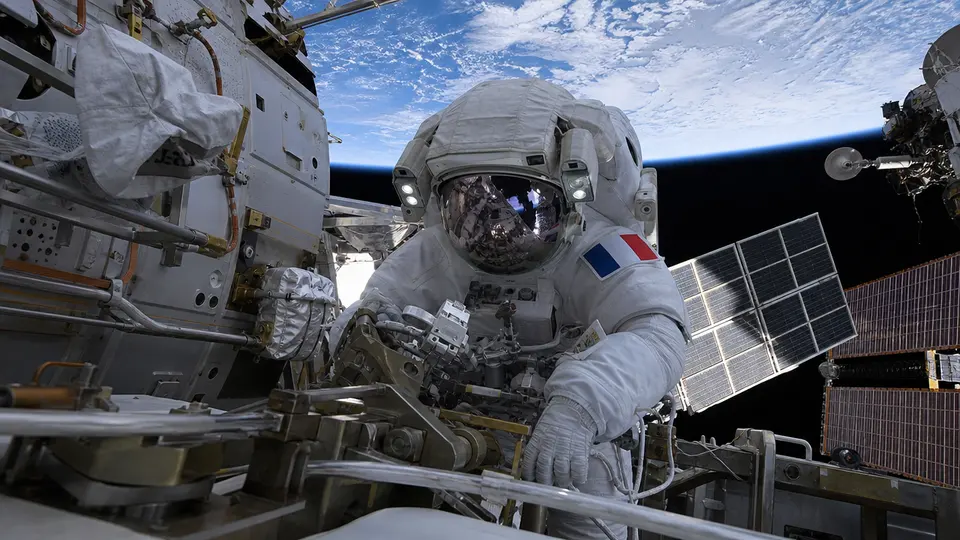
Adenot Returns for Second ISS Spacewalk
Science
Adenot Returns for Second ISS Spacewalk
 Science
AI-Designed Viruses Raise Biosecurity
Science
AI-Designed Viruses Raise Biosecurity
 Science
Octopus Mutation Linked to Intelligence
Science
Octopus Mutation Linked to Intelligence
 Science
Scientists Recreate Primordial Plasma in Mini Big Bang Test
Science
Scientists Recreate Primordial Plasma in Mini Big Bang Test