Scientists Recreate Primordial Plasma in Mini Big Bang Test
- Researchers collided oxygen-16 and neon-20 nuclei at near-light speed, producing quark-gluon plasma in what they describe as a 'mini Big Bang'.
- Quark-gluon plasma, considered the most ancient form of matter, formed as a tiny droplet lasting a fraction of a second before expanding.
- The study found that nuclei significantly smaller than lead are sufficient to generate the extreme conditions needed to produce quark-gluon plasma.
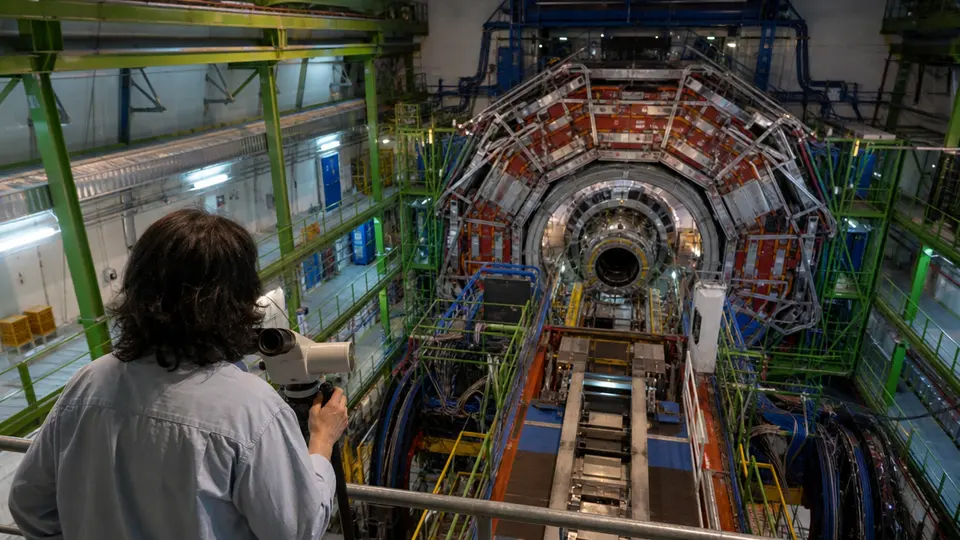
Scientists have reproduced a form of matter believed to have existed in the very first moments of the universe, by colliding nuclei of oxygen-16 and neon-20 at velocities approaching the speed of light — an event researchers have described as a "mini Big Bang".
A droplet born in a fraction of a second
When the nuclei collide at near-light speed, their constituent parts briefly coalesce into a tiny droplet of quark-gluon plasma. The collision itself lasts only a fraction of a second before the plasma expands outward, replicating — on an extraordinarily small scale — the conditions thought to have prevailed immediately after the universe came into being.
Quark-gluon plasma is regarded by researchers as the most primordial state of matter in existence, predating the formation of protons and neutrons. The substance is composed of quarks and gluons in an unbound, superheated state.
Smaller nuclei sufficient to trigger extreme conditions
A notable finding of the study is that nuclei considerably smaller than lead — which has historically been used in high-energy collision experiments — are capable of generating the extreme conditions required to produce quark-gluon plasma. The use of oxygen-16 and neon-20 demonstrates that the threshold for creating this primordial state may be lower than previously understood, though the precise implications of this remain to be determined by further research.
If confirmed and extended, the result could broaden the range of experimental approaches available to physicists seeking to probe the conditions of the early universe.