Octopus Mutation Linked to Intelligence
- Scientists identified a unique ribosomal RNA break in shallow-water octopuses that roughly doubles protein-synthesis accuracy when replicated in E. coli bacteria.
- The mutation was present in all five incirrate (shallow-water) octopus species examined but absent in a deep-sea cirrate species and in squids, which diverged from octopuses
- Researchers suggest the adaptation may have supported the evolution of complex octopus nervous systems and could, speculatively, inform future drug therapies for Alzheimer's and
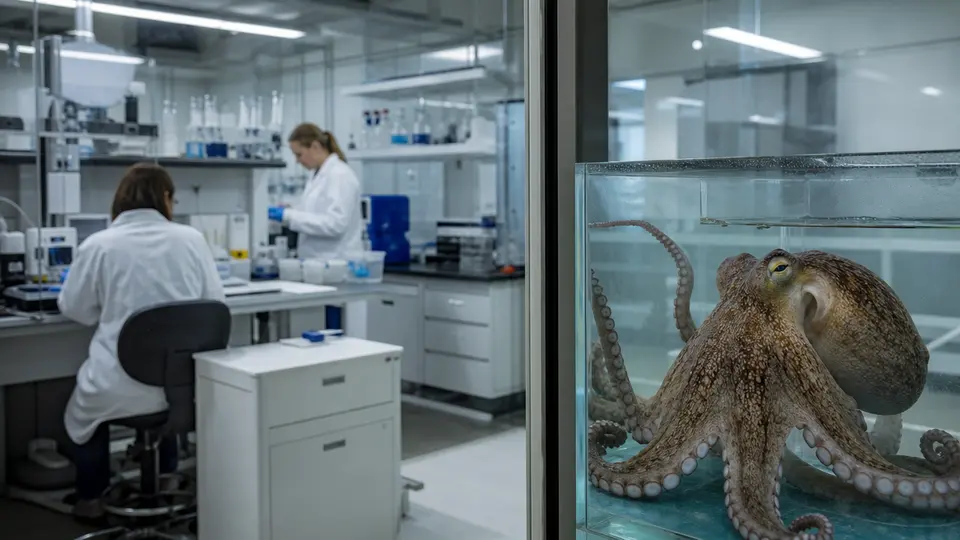
Scientists have identified a previously unknown mutation in the ribosomal RNA of certain octopuses that enables their cellular protein factories to operate with extraordinary accuracy — a finding that may shed light on how these animals evolved their remarkable intelligence, and that researchers believe could one day inform treatments for neurodegenerative diseases in humans.
An accidental discovery
The discovery was made by accident roughly five years ago when Richard Han, then a graduate student at Harvard Medical School, was examining molecules called ribosomal RNA (rRNA) in tissue samples from the California two-spot octopus. Ribosomal RNA creates a three-dimensional scaffold for ribosomes, the cellular machinery responsible for building proteins. Most rRNA sequences are highly conserved across the animal kingdom — yet Han noticed an unexpected gap in the octopus sequences, splitting what is ordinarily a single rRNA fragment into two. The team's initial assumption was that the anomaly was a laboratory error. "We figured we were bad at extracting RNA," said study co-author Nicholas Bellono, a molecular biologist at Harvard. Further testing confirmed otherwise.
What the mutation does
To assess the functional significance of the break, the researchers inserted an equivalent gap into the ribosomes of Escherichia coli bacteria. The engineered cells produced proteins with approximately twice their usual accuracy, suggesting that the structural alteration meaningfully improves the fidelity of protein synthesis. The study was published in the 17 August issue of the journal Current Biology.
A split between lineages
To determine when the mutation arose in evolutionary terms, the team compared two octopus groups that diverged more than 100 million years ago: incirrates, shallow-water species with expanded nervous systems capable of complex behaviours, and cirrates, deep-sea creatures with simpler nervous systems adapted to slow movement and passive feeding. The rRNA break was present in all five incirrate species examined. A sample from a cirrate — specifically, a dumbo octopus — lacked the gap entirely. Squids, which diverged from octopuses approximately 300 million years ago, also did not carry the mutation.
A possible but unproven link to brain complexity
The researchers are careful to note that there is no direct evidence establishing a causal connection between the rRNA mutation and the enlarged nervous systems of shallow-water octopuses. Nevertheless, they suggest the correlation is suggestive. Neurons are long-lived cells for which protein misfolding is particularly damaging, study co-author Rishav Mitra has noted; by improving the accuracy of protein production, the rRNA adaptation "might help these neurons to work well." The team's hypothesis is that as shallow-water octopuses faced intensifying competition and predation pressure, their nervous systems expanded rapidly, and the mutation may have provided a selective advantage in sustaining that complexity. "The major surprise is that the ribosome, which is highly conserved across life, can actually undergo evolutionary changes that impact function, and may even contribute to new innovations," said study co-author Amy Lee, a cell biologist at Harvard.
Joshua Rosenthal, a molecular biologist at the Marine Biological Laboratory who was not involved in the research, described the discovery as "super interesting" but cautioned that further work is required to establish whether the rRNA change was a driver of sophisticated brain evolution rather than a correlate of it. "We're just getting to the beginning of genetics with these organisms," he said.
Implications for human medicine
The study authors believe their findings could carry implications beyond cephalopod biology. Several neurodegenerative diseases — including Alzheimer's and Parkinson's — involve the accumulation of misfolded proteins in the brain. Lee has said she hopes it may prove possible to design drugs that replicate the octopus mutation's effect in human cells, using the natural adaptation as a blueprint for improving protein-synthesis accuracy. If researchers can "use nature as a guide to understand how that happens naturally," she has said, "then we can probably find ways to put it into human cells." Those therapeutic possibilities remain speculative, and significant additional research would be required before any clinical application could be considered.
More in Science
→ Science
Adenot Returns for Second ISS Spacewalk
Science
Adenot Returns for Second ISS Spacewalk
 Science
AI-Designed Viruses Raise Biosecurity
Science
AI-Designed Viruses Raise Biosecurity
 Science
Scientists Recreate Primordial Plasma in Mini Big Bang Test
Science
Scientists Recreate Primordial Plasma in Mini Big Bang Test
 Science
The Moon Explained: Orbits, Gravity and Lunar Science
Science
The Moon Explained: Orbits, Gravity and Lunar Science
 Science
Robots Could Turn Iceland's Lava into Building Material
Science
Robots Could Turn Iceland's Lava into Building Material
 Science
Artemis II Crew to Receive Congressional Space Medal of Honor
Science
Artemis II Crew to Receive Congressional Space Medal of Honor