Washington Marks One Year of National Guard Patrols
- One year after Trump deployed troops to Washington citing crime, around 4,500 National Guard soldiers remain on patrol, outnumbering the Metropolitan Police Department's 3,800
- The Congressional Budget Office projects the Washington deployment will cost nearly $3 billion by the end of Trump's presidency in 2029, with the Niskanen Center estimating
- Independent analysts and a Reuters review of 16,000 court records found troops were concentrated in low-crime, wealthier neighbourhoods, with experts unable to attribute
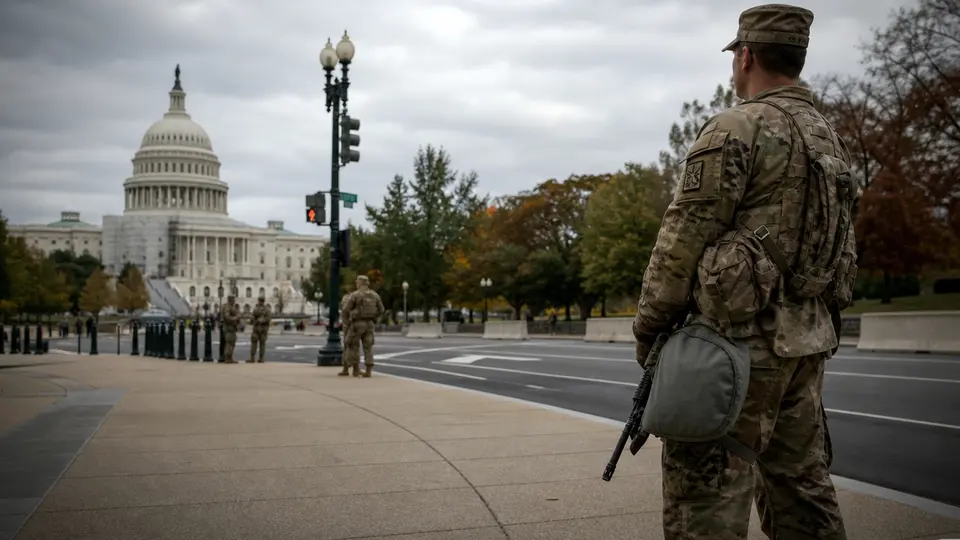
One year after Donald Trump ordered National Guard troops onto the streets of the American capital, approximately 4,500 soldiers continue to patrol Washington DC — outnumbering the Metropolitan Police Department's roughly 3,800 officers — as public opposition hardens, costs mount and independent analysts question whether the deployment has meaningfully reduced serious crime.
The pretext and the rhetoric
Trump announced the deployment in mid-August 2025, declaring that Washington had been "taken over by violent gangs and bloodthirsty criminals" and vowing that "crime, savagery, filth and scum will disappear." The announcement followed an attempted carjacking targeting Edward Coristine, an employee of the Department of Government Efficiency (DOGE), which Trump used as the immediate justification for putting troops on the streets. At the time of the announcement, however, Metropolitan Police Department data showed that violent crime in the capital had already fallen by 35% in 2024, the year before Trump returned to the White House, and that crime statistics overall were at their lowest level in 30 years.
What the troops actually do
Since their deployment, groups of National Guard members have patrolled major avenues, positioned themselves at Metro stations and marched through tourist landmarks including the National Mall. Dressed in military uniform and carrying pistols and handcuffs, they have largely served as a visible deterrent rather than an active law-enforcement presence. A judge barred them from conducting arrests without a prior warrant; they may detain suspects temporarily but must summon police officers to formalise any arrest. During the operation's early months, soldiers were frequently observed emptying rubbish bins, doing park maintenance and clearing snow — tasks unrelated to public safety. Many residents say the sight of armed troops on civilian streets has left them feeling unsettled rather than reassured.
Cost, scale, and duration
The operation is, by any measure, substantial. The Congressional Budget Office estimated its cost at $225 million in 2025 alone, with each additional month adding approximately $55 million. At that rate, the CBO projects the Washington deployment will have cost nearly $3 billion by the time Trump's presidency ends in January 2029. The White House has already issued an order keeping the troops in place until that date. The Pentagon has approved a budget of nearly $300 million to move soldiers out of costly hotel accommodation and into apartment buildings — a move that underlines the long-term nature of the mission. A conservative think tank, the Niskanen Center, estimated that the government spends $607 a day on each soldier, compared with $384 for a Metropolitan Police officer. Democratic Senator Chris Coons of Delaware argued that the same resources would be better spent directly: "If you actually want to improve public safety in the District of Columbia, give the District of Columbia Police Department $100 million to go hire competent, qualified, appropriately trained police."
At its operational peak — the week of celebrations marking the 250th anniversary of American independence — more than 5,000 troops drawn from 18 states, nearly all of them Republican-led, were deployed across the capital. Trump also sent troops to other Democrat-run cities including Los Angeles, Chicago and Portland, but a court order compelled their withdrawal at the end of last year. The Washington deployment remains ongoing, and the White House has described the operation there as distinct.
Disputed impact on crime
Trump claimed last week from the Oval Office that crime in Washington is "down 84%," attributing the fall directly to his decision. Independent analysts are more circumspect. The Niskanen Center found that the military presence may have had a measurable effect on opportunistic offences such as shoplifting and petty theft, but not on more serious violent crimes. "While the Guard's deployment reduced the occurrence of specific crimes, it was (and remains) a blunt and expensive instrument," the think tank's report concluded. Experts have also noted that crime has been declining across the United States broadly, making it difficult to isolate any effect attributable to the Washington deployment specifically. A Reuters analysis of 16,000 court records found that National Guard units were dispatched predominantly to minor incidents in wealthier, predominantly white neighbourhoods with comparatively low crime rates, while southeastern districts such as Anacostia — among the city's most deprived areas — saw troops only rarely.
Opposition from residents, civil liberties groups and the mayor
Around 50 demonstrators gathered at the corner of 14th Street and U Street — one of Washington's busiest intersections — to mark the anniversary, carrying signs reading "Troops Out of D.C." and "Free D.C. Send the Troops Home." Benjamin Zinevich Rodríguez, a 29-year-old spokesman for the Party for Socialism and Liberation, said the protest aimed to draw attention to local residents' opposition to "military troops, federal agents and the migra." A poll conducted by The Washington Post found that 79% of Washington residents oppose the deployment.
Monica Hopkins, head of the American Civil Liberties Union of DC, warned explicitly against the normalisation of armed patrols. "We cannot become numb to the sight of military troops patrolling our neighbourhoods," she wrote, arguing that National Guard forces "must not be political props" and should be reserved for genuine emergencies such as natural disasters. José Nunn, writing for the liberal Brennan Center for Justice, went further, arguing that "the idea of the military supplanting civilian authorities for any reason, no matter how temporary, is simply incompatible with our constitutional system." Washington's Mayor Muriel Bowser described ongoing troop deployments and immigration enforcement activity as "problematic," adding that the city had demonstrated "practically and politically that there was no need for extended federal emergency action."
An unprecedented domestic operation
Until the commencement of the Iran war, the Washington deployment was the largest domestic military operation undertaken by the Pentagon in the modern era. Soldiers are trained for overseas operations and receive little preparation for civilian policing, which demands a distinct set of skills; the Trump administration designated them as federal marshals to provide enforcement authority, though judicial rulings subsequently curtailed their powers of arrest. Trump's broader willingness to invoke emergency powers for domestic political purposes has drawn sustained criticism from civil liberties organisations and constitutional scholars throughout his second term. Whether the deployment in Washington ultimately reduces serious crime — or merely displaces it and deepens civic unease at enormous public expense — remains, a year on, an open and contested question.
More in Crime & Justice
→ Crime & Justice
Eleven Cases Cloud Spain's Autumn
Crime & Justice
Eleven Cases Cloud Spain's Autumn
 Crime & Justice
Copacabana Lynching Shocks Brazil
Crime & Justice
Lockerbie Trial Postponed Again
Crime & Justice
Copacabana Lynching Shocks Brazil
Crime & Justice
Lockerbie Trial Postponed Again
 Crime & Justice
Third Leipzig Drone Carried Hexogen
Crime & Justice
Third Leipzig Drone Carried Hexogen
 Crime & Justice
Family Stranded 26 Days in Ceuta Estate
Crime & Justice
Family Stranded 26 Days in Ceuta Estate
 Crime & Justice
Post Offices Used to Launder Dirty Cash
Crime & Justice
Post Offices Used to Launder Dirty Cash