Deutsche Bahn Cancels 8% of Trains
- Deutsche Bahn cancelled 8% of long-distance trains in the first half of 2026, up three percentage points on the same period last year.
- The cancellation rate is the second-highest recorded since 2019, exceeded only by the strike-affected first half of 2024 when 12% of services were cancelled.
- Green MP Matthias Gastel, whose Bundestag inquiry prompted the disclosure, called for stronger preventive maintenance and more reserve capacity at key rail hubs.
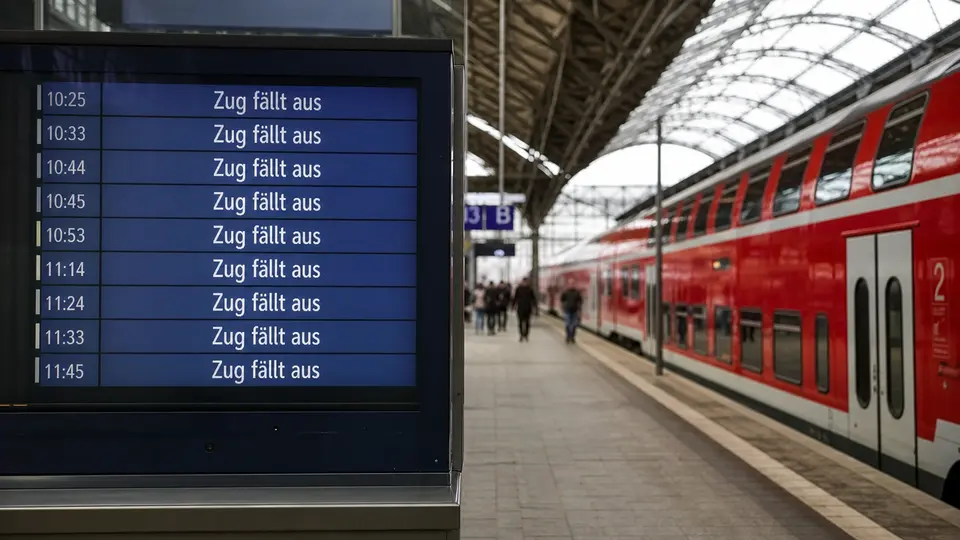
Deutsche Bahn cancelled or partially cancelled nearly one in every twelve long-distance trains during the first half of 2026, according to figures disclosed by the Federal Transport Ministry, placing the operator's cancellation rate at its second-worst level since 2019.
Eight per cent of services fail to run
Eight per cent of DB long-distance services either did not run at all or were cancelled on part of their scheduled route between January and June this year. That figure is three percentage points higher than in the equivalent period last year. The only worse comparable period was the first half of 2024, when cancellations reached 12 per cent — a spike attributed at the time to prolonged industrial action by the Gewerkschaft Deutscher Lokomotivführer (GDL), the train drivers' union. This year's deterioration appears unrelated to strike action, though the source material does not detail alternative causes beyond vehicle faults.
Punctuality figures compound the picture
Deutsche Bahn separately reported that only 58.7 per cent of its long-distance trains arrived on time in the first six months of the year. The operator's own punctuality methodology does not factor in cancelled services, meaning the proportion of passengers experiencing reliable journeys is likely lower still than that figure implies.
Parliament presses for action
The figures emerged from a written response by the Federal Transport Ministry to a parliamentary inquiry tabled by the Greens faction in the Bundestag. Matthias Gastel, the Green MP responsible for the inquiry, said the government and Deutsche Bahn could not afford to stand idle. He attributed much of the disruption to faults with rolling stock and called for more robust preventive maintenance programmes, as well as additional reserve trains and staff to be stationed at major network hubs.
The data adds to a broader set of pressures bearing on Germany's rail infrastructure. Separate threats of industrial action over conductor safety have compounded uncertainty on the network, while questions over long-term investment in reliability remain unresolved. Whether the federal government will respond to Gastel's calls with concrete measures has not been confirmed.
More in Economy
→ Economy
EU Exports Underpin 7.2m German Jobs
Economy
EU Exports Underpin 7.2m German Jobs
 Economy
Balearic Residents Flee to Asturias
Economy
Balearic Residents Flee to Asturias
 Economy
Brazil Vehicle Financing Hits 17-Year High in July
Economy
Brazil Vehicle Financing Hits 17-Year High in July
 Economy
Trump Threatens 50% Tariffs on Canada as Trade War Deepens
Economy
Trump Threatens 50% Tariffs on Canada as Trade War Deepens
 Economy
Iceland Votes on EU Membership Amid Record Living Costs
Economy
Iceland Votes on EU Membership Amid Record Living Costs
 Economy
Trump Announces 50% Tariffs on Canadian Vehicles and Steel
Economy
Trump Announces 50% Tariffs on Canadian Vehicles and Steel