Trump Wall Threatens Ancient Rock Art
- Trump's border wall construction plans are alleged to threaten Indigenous rock art in west Texas estimated to be around 4,000 years old.
- Archaeologist Carolyn Boyd of Texas State University describes murals up to 30 feet tall painted near the Pecos River and Rio Grande using pigments ground from gypsum, hematite,
- The paintings have been characterised as among the oldest-known books in North America, though the precise threat level to specific sites from planned construction remains
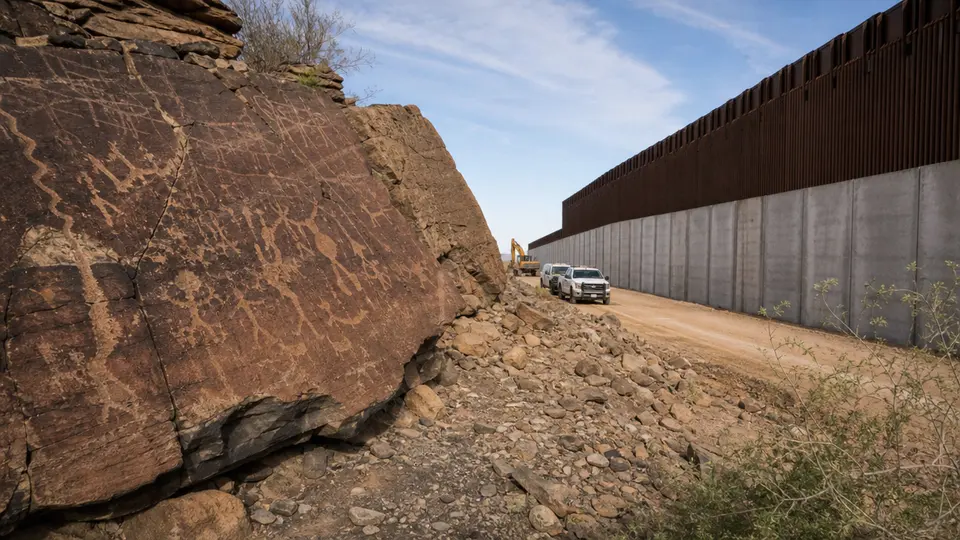
Donald Trump's border wall construction programme could damage or destroy rock art in west Texas that archaeologists believe is approximately 4,000 years old — paintings created by Indigenous hunter-gatherers around the same period as the Egyptian pyramids and described by researchers as among the oldest-known books in North America.
An extraordinary record under threat
Carolyn Boyd, an archaeologist at Texas State University and a practising artist, has studied the murals at close quarters. Standing beneath a cave near the confluence of the Pecos River and the Rio Grande, she described three towering human-like figures painted on a rock wall, some stretching up to 30 feet in height, sheltered by a natural overhang that has protected them from the elements for millennia.
Boyd has reconstructed the immense collective effort required to produce the paintings. The Indigenous bands who lived in this west Texas valley would have spent weeks grinding gypsum, hematite, limonite and manganese into pigment, and gathering large quantities of sotol stalks to fashion into scaffolding. The act of painting itself demanded precise coordination — people at the base directing artists higher up the wall as they worked on figures of exceptional scale.
The scale of what could be lost
The precise nature and extent of the threat to these specific sites from border wall construction has not yet been fully established. What is not in dispute is that infrastructure works of the kind proposed along the southern border carry well-documented risks for fragile archaeological sites, and that the murals in question represent an irreplaceable cultural record. Whether or how federal heritage protections would apply to any construction activity in the area remains unresolved.
The warning from Boyd and her colleagues points to a broader tension that has accompanied successive waves of border enforcement: the degree to which the drive to build physical barriers along an ancient and historically layered landscape can be reconciled with the preservation of what lies within it.
More in Culture & Arts
→ Culture & Arts
Why Penthouses Became Status Symbols
Culture & Arts
Why Penthouses Became Status Symbols
 Culture & Arts
Belgian Pie-Thrower Godin Dies at 80
Culture & Arts
Belgian Pie-Thrower Godin Dies at 80
 Culture & Arts
Shetland's Spanish Armada Legend
Culture & Arts
Shetland's Spanish Armada Legend
 Culture & Arts
Turner Prize Winner's Sound Evidence
Culture & Arts
Freddie Mercury Costumes on Show at V&A
Culture & Arts
Kit Harington Joins Harry Potter Series
Culture & Arts
Turner Prize Winner's Sound Evidence
Culture & Arts
Freddie Mercury Costumes on Show at V&A
Culture & Arts
Kit Harington Joins Harry Potter Series