Shetland's Spanish Armada Legend
- Around 300 survivors of the Spanish Armada supply vessel El Gran Grifón reached Fair Isle in 1588, but the popular legend that they fathered a line of Spanish-descended
- Author Ann Cleeves based her BBC detective Jimmy Pérez on the unverified legend, seeking a character who was authentically local yet perpetually felt an outsider.
- Shetland's Rosebank oil field — licensed by the previous government but opposed by environmental groups — is described as one of the first major decisions facing British Prime
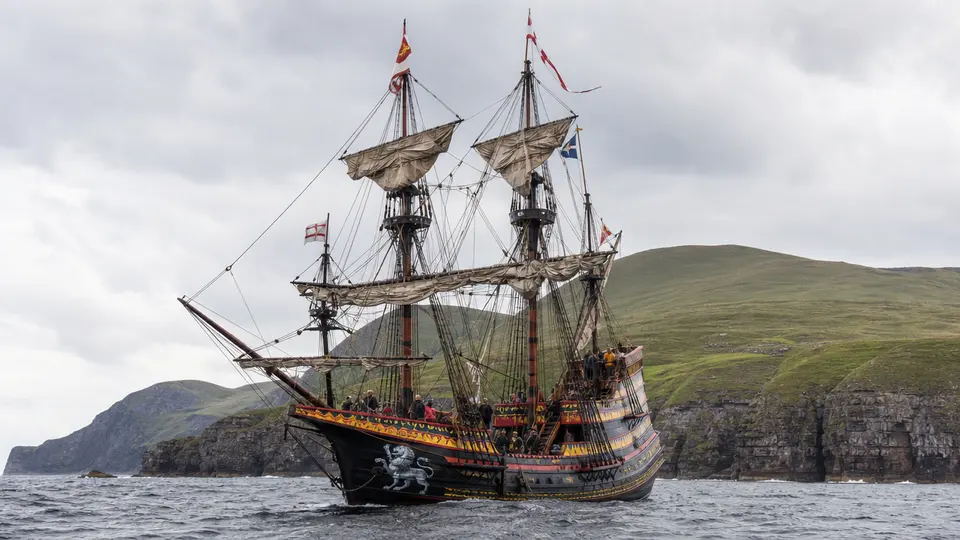
When outsiders leave the pub on Mounthooly Street in Lerwick, locals are said to exchange conspiratorial glances. Their dark hair, deep-set eyes and olive complexions stand out sharply against the predominantly Nordic features of Shetland's population — and the whispered question, according to the legend, is always the same: could they be descended from the Spanish sailors who washed ashore here in 1588?
The wreck of El Gran Grifón
In the autumn of 1588, the Spanish Armada supply vessel El Gran Grifón was driven southward by storms and fierce winds toward Fair Isle — a remote outcrop lying between Shetland and Orkney — after fleeing the English fleet following the disastrous Battle of Gravelines. The ship struck the cliffs, and around 300 sailors and soldiers survived. Roughly 50 of them did not live long: they perished from hunger or disease and are buried in a Fair Isle cemetery beside an iron cross. One survivor recorded his experience in a diary, describing an island of seventeen households living in something resembling cabins, subsisting on barley bread, fish, peat-fired hearths, and the milk, butter, wool and eggs of their livestock, with little to spare for stranded strangers. When news of the survivors reached the island's proprietor, a man named Andrew Umphray, he organised a rescue of those still alive and invited the ship's commander, Juan Gómez de Medina, to convalesce at his residence in Shetland, while the crew was transferred to Orkney.
A legend without genealogical foundation
The romantic notion that some of those Spanish sailors stayed on, married into the local community and left descendants is, by the source material's own account, a myth unsupported by any genealogical evidence or DNA research. Among Shetland's approximately 23,000 inhabitants, no López, García, Fernández or Martínez appears in the records. Across the water in Orkney, however, some Spanish sailors are said to have settled; their reputed descendants are known as the Westray Dons. The Shetland legend, though unverified, proved irresistible to crime novelist Ann Cleeves, who drew on it when creating Detective Jimmy Pérez — a man with a Spanish surname who is unmistakably a Shetlander yet perpetually feels like an outsider. Played by Douglas Henshall in the BBC television adaptation, Pérez became the series' defining character. Cleeves, the series, and the tradition of placing brooding crime drama in remote British landscapes have together kept the Armada legend alive in popular culture long after any historical trace has faded. As for violent crime in Shetland: the source is emphatic that the lurid murders of the television series bear no relation to reality. Criminality on the islands is described as extremely low.
An identity suspended between north and south
Fair Isle today is isolated but not impoverished. It has no pub, no hospital, one shop that doubles as a post office, and two Protestant churches of different denominations — both attended on Sundays, by tradition. Women still knit the islands' celebrated Scandinavian-influenced wool sweaters, similar in style to Faroese knitwear and purchased by luxury retailers. The broader Shetland archipelago is geographically closer to Norway than to Scotland, and it arrived within British sovereignty only by accident: in the 15th century, the Danish King Christian I pledged the islands to the Scottish King James III as surety for a dowry of 60,000 florins. Unable to redeem the pledge, Christian I saw the Scottish parliament formally annex the islands in 1472. The result is a population that, according to the source material, feels neither entirely Scandinavian nor entirely Scottish, and which seeks greater autonomy — along the lines of the Faroe Islands, or a status resembling that of the Isle of Man — alongside a larger share of the revenues generated by its own natural resources. The sea that once brought shipwrecked Spaniards to these cliffs now sits atop what makes Shetland economically exceptional.
Oil, autonomy and the Rosebank question
The discovery of North Sea oil roughly half a century ago transformed Shetland from a fishing community into what is described as the energy capital of the United Kingdom. The islands hold the country's largest oil reserves and land more fish than England and Wales combined. The Shetland Council — an administrative body composed predominantly of independent politicians unaffiliated with the major parties — negotiated a deal with London to retain 2.5 per cent of crude profits. The resulting sovereign wealth fund, modelled loosely on Norway's, is now valued at close to one billion euros. The dividends are visible: public lavatories in Lerwick's Commercial Street are described as comparable to a five-star hotel, bus drivers may earn approximately €70,000 a year, roads reach the most remote settlements in impeccable condition, each village has a heated swimming pool and sports centre, and some schools serve just one or two pupils. That prosperity is, however, under pressure: Edinburgh's budget allocation is reportedly shrinking, obliging the council to draw on the oil fund. The central question now is whether, and when, the Rosebank oil field — located 120 kilometres north-west of Shetland and estimated to hold up to 500 million barrels — will be developed. A licence was granted by the previous government, but environmental groups oppose the project. The decision is said to represent one of the first major dilemmas for the current British Prime Minister, Andy Burnham, who has set reducing the cost of living as a central policy objective. The outcome will have consequences that extend well beyond these windswept northern islands.
More in Culture & Arts
→ Culture & Arts
Why Penthouses Became Status Symbols
Culture & Arts
Why Penthouses Became Status Symbols
 Culture & Arts
Belgian Pie-Thrower Godin Dies at 80
Culture & Arts
Belgian Pie-Thrower Godin Dies at 80
 Culture & Arts
Turner Prize Winner's Sound Evidence
Culture & Arts
Freddie Mercury Costumes on Show at V&A
Culture & Arts
Kit Harington Joins Harry Potter Series
Culture & Arts
Turner Prize Winner's Sound Evidence
Culture & Arts
Freddie Mercury Costumes on Show at V&A
Culture & Arts
Kit Harington Joins Harry Potter Series
 Culture & Arts
French Broadcaster Bouvard Dies at 96
Culture & Arts
French Broadcaster Bouvard Dies at 96