The Long Decline of Public Toilets
- Paris banned public urination in 1850 and introduced ornate cast-iron pissoirs, which were designed for men only and quickly became unintended meeting places for same-sex
- In the United States, temperance advocates campaigned for public comfort stations to free citizens from dependence on saloon facilities, but their construction stalled during
- Public toilet provision in major American cities has effectively collapsed, leaving bodily privacy as a commercial transaction rather than a civic right, according to historical
In 1850, Paris banned public urination and, in doing so, created one of the most elaborate — and contested — pieces of street furniture the modern city has ever produced. The story of how public lavatories rose and fell on both sides of the Atlantic is also a story about who belongs in public space, and what governments owe their citizens.
The Pissoir and Its Unintended Uses
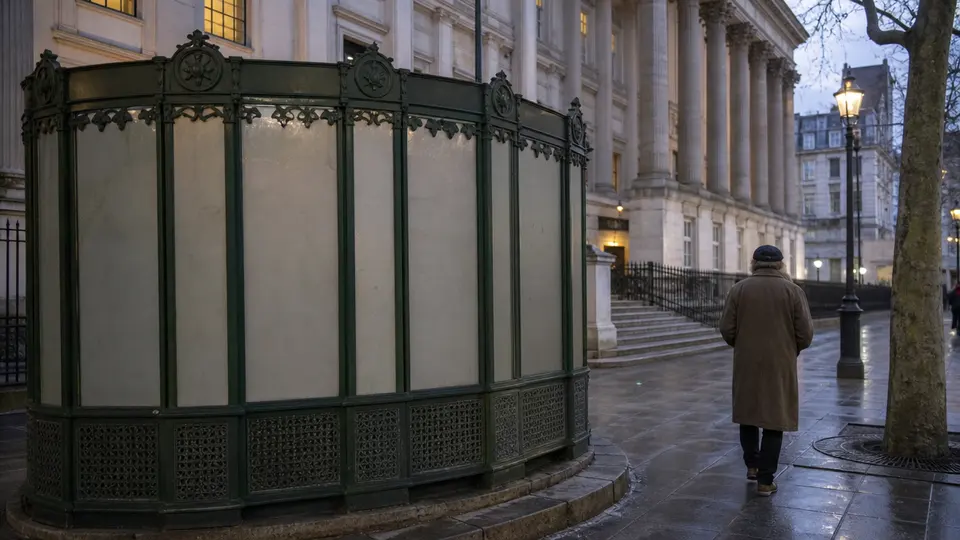
Before the prohibition, Parisian authorities had relied on what were known as empeche pipi — hostile architectural interventions such as iron spikes and bullnose masonry designed to redirect would-be urinating pedestrians rather than accommodate them. A series of devastating cholera outbreaks in the mid-1800s shifted official thinking: human waste was now a public health hazard, not merely an annoyance. The solution was the pissoir, or vespasienne — cast-iron kiosks decorated with grilles, scrollwork, metal flowers, and in some cases small lions' heads, illuminated by gas lamps and plastered with advertisements for perfumers and wine merchants apparently unbothered by the association.
They were designed exclusively for men. The working assumption, as sociologist Andrew Israel Ross has documented in Dirty Desire: The Uses and Misuses of Public Urinals in Nineteenth-Century Paris, was that women were not meaningfully present in public life and therefore had no need for relief whilst outdoors — a circular logic that helped ensure the very absence it presumed. Almost immediately, the pissoirs acquired a secondary, unplanned function: they became meeting places for men seeking same-sex encounters, offering relative privacy and anonymous communication through graffiti. The police responded with patrols; blackmailers followed.
Ross frames the episode as emblematic of a broader urban dynamic: "the tendency of the built environment to exceed the control of those who conceived it … is a distinguishing feature of modern urban life."
Temperance, Saloons, and the American Comfort Station
Across the Atlantic, the public toilet had become entangled with a very different moral crusade. In the absence of dedicated facilities, American saloons had become the de facto public bathroom network for most major cities. Historian Peter C. Baldwin, writing in Public Privacy: Restrooms in American Cities, 1869–1932, records how temperance advocates seized on this dependency. If abstinence was the goal, people would still need somewhere to relieve themselves once the saloons were closed. A 1913 Chicago Tribune article, quoted by Baldwin, captured the frustration bluntly: "Why are we compelled to run the gauntlet past the beer bar, the bartender, and subject to the searching glance of this white-aproned gentleman, until in shame we start to spend money for booze?"
The temperance movement's answer was the large, multi-stalled underground comfort station — a far more enclosed and private proposition than the Parisian urinal. For a time, these were built. But the construction of public facilities had an unintended consequence: privately owned establishments — hotels, restaurants, shops — which had previously permitted use of their lavatories began to restrict access to paying customers, reasoning that public provision now existed. When Prohibition finally arrived and then collapsed, investment in public infrastructure dried up. The comfort stations that had been built fell into disrepair.
Bodily Privacy as a Purchasable Commodity
The long-run consequence, felt acutely in cities such as Chicago and New York, is a near-total absence of freely accessible public facilities. City pedestrians are dependent on semi-private buildings — coffee shops, hotels, department stores — and access is mediated by commercial transaction or at least the expectation of one. As Baldwin's account makes plain, what was once framed as a civic right — the ability to relieve oneself in a public space without cost or obligation — has been quietly reclassified as a private arrangement, one "inflected by judgments of the individual's social status."
The history sits in uncomfortable parallel with contemporary debates about urban sanitation. London's own sewerage strains in recent summers have renewed questions about what cities owe their residents at the most basic level. The answer, if the history of the public toilet is any guide, has rarely been settled on purely practical grounds — politics, morality, and commerce have always had a say. What remains unresolved is whether bodily privacy should ever have been surrendered to the market in the first place.