Germany Heatwave Costs Hit €36bn
- Greenpeace estimates Germany's 2026 heat periods caused at least €36bn in economic damage, equal to roughly 0.9% of GDP.
- Productivity losses (€10.8bn), forest damage (up to €7.5bn), and Rhine shipping disruption (up to €4.5bn) are the three largest components identified.
- Greenpeace acknowledges the figures are estimates with data gaps, and warns that the full costs — including energy system and air-quality impacts — remain unquantifiable.
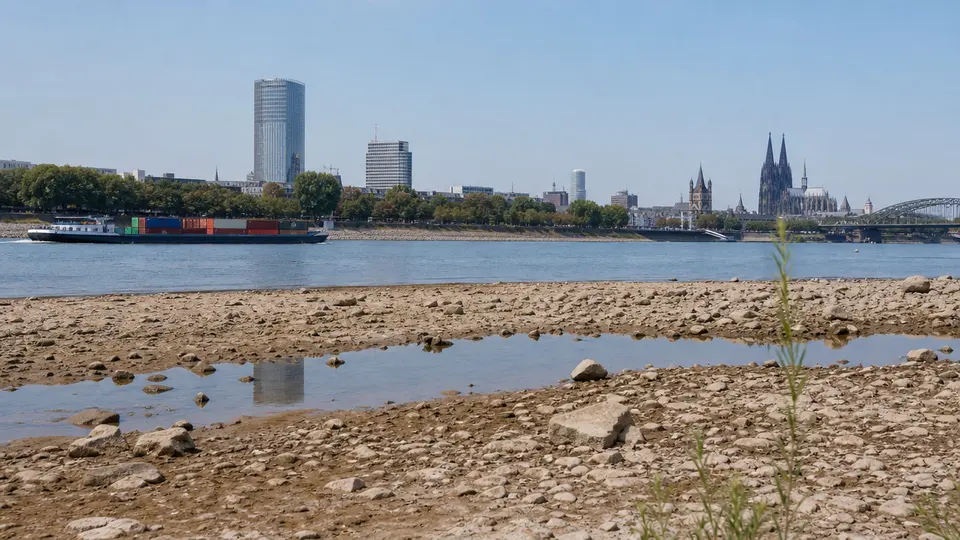
Germany's prolonged heat periods this year have caused economic damage of at least €36 billion, according to an estimate by the environmental organisation Greenpeace — a figure equivalent to between 0.8 and 0.9 per cent of the country's gross domestic product.
What the estimate covers
Greenpeace attributes the losses to four main drivers: harvest failures, wildfires, higher healthcare costs, and productivity losses. The single largest component identified in the estimate is the productivity impact, which the organisation puts at €10.8 billion, calculated on the basis of 25 heat days. Forest damage accounts for a further estimated €7.5 billion, whilst low water levels on the Rhine are said to have caused shipping disruptions worth up to €4.5 billion — a finding that chimes with earlier reporting on the historic lows affecting Rhine ferry services.
Greenpeace financial expert Mauricio Vargas described this year's conditions as "a catastrophe — for millions of people and for the economy", adding: "Even if this natural disaster does not leave rubble, the scale of the damage is shocking."
Acknowledged uncertainties
Greenpeace itself concedes that its headline figure is an estimate produced under conditions of incomplete data, noting that "certain imprecisions in quantification" were unavoidable. Vargas defended the methodology, however, arguing that refusing to account for damages owing to data gaps "would lead to significantly larger knowledge gaps and massively underestimate the scale of the natural disaster."
Corroboration from other sources
The Greenpeace estimate does not stand alone. Before the calendar start of summer this year, the credit insurer Allianz Trade published research suggesting Germany could face cumulative heat-related economic losses of around €112.5 billion by 2030. Separately, a study by the research and consulting firm Prognos AG, commissioned by the Federal Ministry of Labour and Social Affairs, concluded that a single day with temperatures above 30 degrees Celsius generates roughly €431 million in economic damage across Germany — with 97 per cent of that stemming from productivity losses alone.
In early August, the Institut der deutschen Wirtschaft warned that low river levels in isolation could reduce GDP by 0.4 per cent, potentially erasing the minimal growth forecast for 2026. The knock-on effect is amplified, the institute noted, by the significantly higher cost of road freight transport at a time of persistently elevated fuel prices. At the most local level, the city of Leverkusen has recorded a loss of approximately €30,000 from the suspension of a passenger ferry service to Cologne — a comparatively modest sum that nonetheless illustrates how numerous small disruptions accumulate across the economy. This pattern of compounding local impacts mirrors the broader drought-driven economic pressures being felt across Europe.
True costs still unknown
Despite the range of estimates now in circulation, Vargas contends that the "true costs" of this heat summer remain impossible to calculate in full. Consequences that have yet to be quantified include the effects on the energy system from reduced cooling-water availability and the health burden from elevated ozone and fine-particle pollution caused by the heat. On the back of these findings, Greenpeace is calling on the federal government to respond to the climate crisis "with the seriousness it demands." The economic toll of European heatwaves is already being measured in the hundreds of billions at EU level, and Germany's figures suggest a substantial share of that burden is falling on Europe's largest economy.
More in Environment & Climate
→ Environment & Climate
Rosebank Climate Costs Dwarf Oil Gains
Environment & Climate
Rosebank Climate Costs Dwarf Oil Gains
 Environment & Climate
Woodside Scraps Emissions Targets
Environment & Climate
Woodside Scraps Emissions Targets
 Environment & Climate
Storm Divide Splits Germany in Two
Environment & Climate
Storm Divide Splits Germany in Two
 Environment & Climate
Nevada Wildfire Evacuates 40,000
Environment & Climate
Nevada Wildfire Evacuates 40,000
 Environment & Climate
France's Summer 2026: Heat, Fire,
Environment & Climate
France's Summer 2026: Heat, Fire,
 Environment & Climate
Indonesia Wildfires Blanket Borneo
Environment & Climate
Indonesia Wildfires Blanket Borneo