France's Summer 2026: Heat, Fire,
- France recorded its highest-ever temperature of 43.8°C on 24 June 2026, with 72 departments and 44 million people placed under red heatwave alert by 25 June.
- Wildfires burned at least 42,000 hectares in Gironde alone — destroying 183 houses in Le Porge — while three firefighters died in a season that by mid-July had already surpassed
- By August, 80% of French territory faced water restrictions, over 15% of the nuclear fleet was offline and more than 40,000 people lost tap water access, with ministers stating
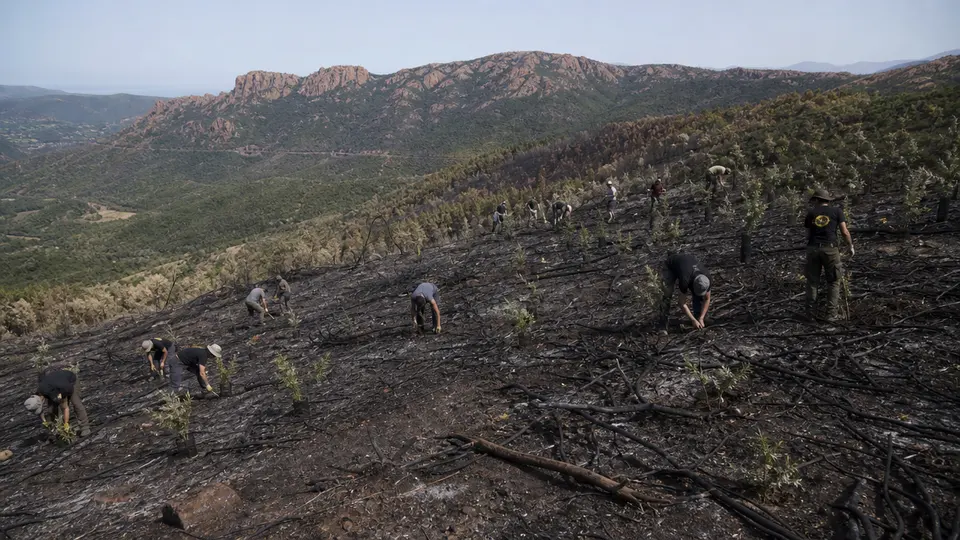
The summer of 2026 inflicted on France a sustained sequence of climate shocks — shattering temperature records, unleashing wildfires of extraordinary scale and driving a drought so severe that ministers described it as worse than anything previously recorded. From the first days of the season to its close, the cumulative toll in lives, homes, farmland and infrastructure laid bare the accelerating consequences of climate change for one of Europe's largest countries.
Record temperatures and overwhelmed hospitals
The crisis announced itself abruptly. On 21 June, Météo-France placed 35 departments under red heatwave alert and a further 45 on orange, warning that the country was facing not a brief spike in temperatures but a durable and spreading event. Three days later, France recorded its hottest day in history. Temperatures reached 43.8°C simultaneously in Palluau in the Vendée, in Saintes and in Pissos in the Landes. Nantes registered 42.2°C; Paris reached 40.3°C.
By 25 June, 72 departments — encompassing 44 million people — were under red alert, with more than 90 per cent of the French population exposed to extreme heat. The duration of the heatwave set its own benchmarks, with a second wave beginning just four days after the first subsided on 30 June.
The human cost was immediate. People died from heatstroke at their workplaces and were found dead in their homes. Hospitals across Île-de-France were declared "saturated" by the regional prefect. Prime Minister Sébastien Lecornu activated level three of the four-tier Orsan emergency plan to reinforce hospital staffing, while the government promised delivery of 30,000 mobile cooling units to health establishments. In a maternity ward in Bordeaux, night-time temperatures inside reached 33°C. Ventilators and air-conditioning units sold out across the country.
The strain extended to infrastructure. Electrical transformers overloaded and exploded in the Var, near Quimper and near La Rochelle, cutting power to tens of thousands of households. In Chanteloup-les-Vignes, in the Yvelines, the outage lasted the better part of a week. Social inequalities sharpened under the heat: some residents paid hundreds of euros for hotel rooms to escape unliveable flats, while others slept in basements or hung emergency foil blankets over their windows. In Clermont-Ferrand, police removed a portable swimming pool that local youths had installed on a public street — a moment that drew widespread condemnation on social media as temperatures in the city reached 41°C.
A wildfire season described as apocalyptic
The fires began on 2 July, when a blaze smouldering in the Diois massif in the Drôme reignited. One evacuated resident described it as "completely savage and outside all norms." Within days it had consumed 4,400 hectares of difficult, inaccessible terrain. On 4 July, a fire broke out in the Pyrénées-Orientales, burning 5,000 hectares in two days and destroying around twenty houses in Rodès and Ille-sur-Têt, near Perpignan.
By 12 July the fires had reached the Paris region, with the Fontainebleau forest — bordered by the A6 motorway — igniting to the disbelief of local residents. Firefighters drafted in from northern France found themselves stretched across multiple fronts simultaneously. "The season is starting early and will last a very long time," said Gilles Devantoy, a commander from the Val-d'Oise. By mid-July, the director-general of civil security, Julien Marion, confirmed that the 2026 season had already surpassed the entire burnt area of the previous year, with 35,000 hectares destroyed.
The worst was still to come. On 21 July, three simultaneous fires ignited in the Var, Gironde and Landes, plunging the country into what the Interior Minister acknowledged publicly as a "totally unprecedented situation." In Gironde, the town of Le Porge was partly razed, with 183 houses destroyed and 42,000 hectares of pine forest consumed within days. Near Biscarrosse in the Landes, 198 houses were lost and 3,600 hectares burned. In the Var, the Gros Bessillon massif burned for nearly three weeks.
At its peak, approximately 2,500 firefighters, 18 aerial assets and 1,500 military personnel were deployed, supplemented by foreign crews from Ukraine, Germany, Portugal, Slovenia and the Czech Republic. Three French firefighters died during the season. Up to 7,000 evacuees were housed in Bordeaux's exhibition centre. Residents of Le Porge described fire trucks with tyres bursting from the heat and firefighters unable to contain the advancing flames. Farmers and local contractors joined the effort with water tankers, yet survivors described scenes of helplessness against fires of extraordinary intensity.
Drought cuts water, crops and nuclear output
Running beneath and alongside the fires was a drought of historic severity. The heatwave compounded months of abnormally low rainfall, and by summer's end 80 per cent of French territory was under official water restriction orders. Lac de Chaillexon in the Doubs dried up entirely in early August. At the Lac de Vassivière in the Creuse, water levels were falling by ten centimetres a day. Algae proliferated in a Loire reduced in places to barely 50 centimetres in depth.
On 11 August, EDF announced that more than 15 per cent of France's nuclear reactor fleet was offline, unable to draw sufficient coolant water from rivers. The following day, the environment minister, Monique Barbut, warned that more than 40,000 people had lost access to tap water entirely, and stated plainly that the situation was more serious than the already-historic drought of summer 2022. Water tankers were despatched to villages across Bourgogne.
Agricultural damage was widespread. Thomas Gibert, spokesman for the Confédération paysanne, the country's third-largest farming union, called on authorities to "grasp the immensity of the crisis," warning of historically low yields across all sectors. Harvests began a full month early. In Strasbourg, the Rhine's exceptional low water level had reduced barge traffic to a single vessel per week, against a normal figure of twenty. The drought's reach extended well beyond France's borders, disrupting river navigation and electricity generation across the continent.
As summer 2026 drew to a close, the accumulated evidence — shattered temperature records, hundreds of homes reduced to ash, tens of millions placed under water restrictions and a nuclear fleet hobbled by drought — pointed to a country being tested, repeatedly and simultaneously, by the compounding consequences of a changing climate.
More in Environment & Climate
→ Environment & Climate
Rosebank Climate Costs Dwarf Oil Gains
Environment & Climate
Rosebank Climate Costs Dwarf Oil Gains
 Environment & Climate
Woodside Scraps Emissions Targets
Environment & Climate
Woodside Scraps Emissions Targets
 Environment & Climate
Storm Divide Splits Germany in Two
Environment & Climate
Storm Divide Splits Germany in Two
 Environment & Climate
Nevada Wildfire Evacuates 40,000
Environment & Climate
Nevada Wildfire Evacuates 40,000
 Environment & Climate
Indonesia Wildfires Blanket Borneo
Environment & Climate
Indonesia Wildfires Blanket Borneo
 Environment & Climate
Germany Heatwave Costs Hit €36bn
Environment & Climate
Germany Heatwave Costs Hit €36bn
Read in another language