Swiss Luxury Watches Hold Their Price
- Four Swiss watch brands — Rolex, Omega, Cartier, and Patek Philippe — account for more than half of total Swiss watch retail sales among roughly 450 brands.
- Switzerland exported 14.6 million watches worth CHF 24.4bn in 2025, a 1.7% volume decline on 2024, though first-half revenues stabilised with only a 0.7% fall.
- The Cartier Crash, launched in 1967 with a Dalí-esque distorted case, now sells for approximately 1.7 million euros, illustrating how heritage and scarcity anchor luxury pricing.
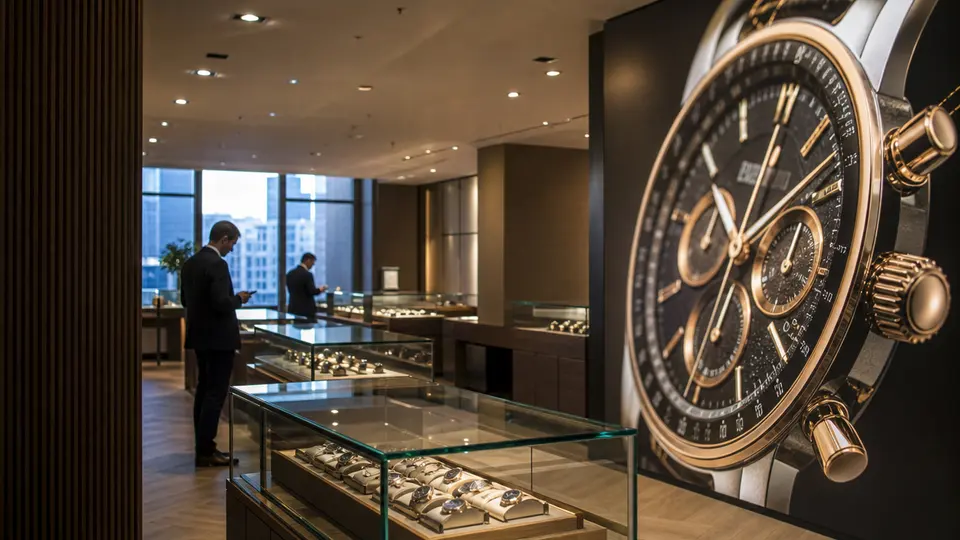
Switzerland's luxury watch industry faces a structural paradox: its products are ultimately constrained by the size of a customer's wrist. Yet four brands — Rolex, Omega, Cartier, and Patek Philippe — have turned that constraint to their advantage, collectively commanding more than half of total retail sales across a Swiss industry that numbers roughly 450 marques.
A market of four
The concentration of market power at the summit of Swiss horology is stark. Among approximately 450 Swiss watch brands, this quartet has steadily absorbed market share, leaving the majority of manufacturers competing for the remaining fraction of consumer spending. The dynamic mirrors broader trends in luxury goods, where dominant names consolidate while smaller labels struggle for visibility.
Export figures stabilise after a difficult year
Switzerland exported watches worth 24,400 million Swiss francs — approximately 27,790 million euros — in 2025, according to the latest available data. In volume terms, that equates to 14.6 million timepieces, representing a fall of 1.7 per cent against 2024, or roughly 740,000 fewer units sold. The decline, while meaningful, has shown signs of easing: figures from the Federation of the Swiss Watch Industry show cumulative revenues for the first half of the year stabilised at 12,800 million francs, a far narrower drop of just 0.7 per cent. The moderation suggests the sector may be finding a floor after a more turbulent twelve months.
Pricing as a strategic instrument
The industry's defence of high prices is most vividly illustrated at the extreme end of the market. The Cartier Crash — a watch whose distorted case gave it the appearance, on its 1967 launch, of having been conceived by Salvador Dalí — now commands a price of approximately 1.7 million euros, a figure that underlines how heritage and scarcity function as pricing levers for the leading houses. The collector market, distinct from the everyday retail segment, operates by its own logic, one in which provenance and rarity outweigh conventional value calculations. The broader strategies by which the major brands sustain elevated price points across their wider catalogues remain a subject of continued scrutiny.
The resilience of Swiss luxury watchmaking at the top of the market stands in instructive contrast to other premium goods sectors navigating uncertain consumer sentiment. As Swiss Alpine vaults for ultra-high-net-worth clients take shape, and as luxury goods brands across Europe court private equity, the watch industry's concentration among a handful of dominant names points to a model in which scale and brand equity increasingly determine survival.
More in Business
→ Business
Klaus-Michael Kühne Dies Aged 89
Business
Klaus-Michael Kühne Dies Aged 89
 Business
VW Workers Slam Board's Crisis Comms
Business
VW Workers Slam Board's Crisis Comms
 Business
VW Works Council Rejects Plant Closures
Business
VW Works Council Rejects Plant Closures
 Business
Alter Ego Seeks £20m for Mayfair Club
Business
Alter Ego Seeks £20m for Mayfair Club
 Business
Scottish Luxury Handbag Brand Nears Private Equity Deal
Business
Scottish Luxury Handbag Brand Nears Private Equity Deal
 Business
Thames Water Creditors Name Directors in Bailout Bid
Business
Thames Water Creditors Name Directors in Bailout Bid