Argentina says a tearful thank you to Lionel Messi
Lionel Messi has announced his retirement from international football in a handwritten letter posted to Instagram on Monday, days after Argentina's defeat to Spain in the 2026 World Cup final in New Jersey, prompting an outpouring of grief and gratitude across Argentina.
Written by James Carter
(4h ago)
What happened?
Lionel Messi, 39, announced his retirement from international football in a handwritten letter posted to Instagram on Monday, following Argentina's defeat to Spain in the 2026 World Cup final in New Jersey.
Why it matters
The retirement closes an era spanning almost 45 years in which either Messi or Maradona appeared in 10 of the past 12 World Cups, prompting widespread mourning and reflection across Argentina.
What’s next?
Messi continues his club career with Inter Miami, where he scored four goals at the weekend, and two upcoming Argentina international fixtures will now proceed without him.
The announcement, when it came, was characteristically understated in form yet seismic in consequence. Lionel Messi posted three handwritten sheets to Instagram on Monday, accompanied by photographs, a Harry Potter Time Turner pen visible in one image, and set to the soundtrack of Brindis by Soledad Pastorutti. The letter confirmed what those who had watched Argentina coach Lionel Scaloni weep uncontrollably at the post-match press conference following the World Cup final had already sensed: something had ended.
Argentina lost that final to Spain in New Jersey on 19 July. Messi revealed that his retirement letter was in fact written two days after the defeat — a cathartic, diary-like release — but that by Monday, following what he described only as what had happened "with my dad", he was more convinced than ever that the time had come. "It's a decision that hurt and continues to hurt," he wrote, while making clear he understood it to be the right one. A small editorial detail, noted by the poet Valeria Correa Fiz, captured something essential: Messi had originally written "I think" before crossing it out and replacing it with "I understand".
The 39-year-old swore he always gave everything — not only in recent years when, as he put it with characteristic deflection, "everything was won" (he never writes "I won"; it is always "we" or simply "it was won") — but that he has nothing left to give at international level. He is not, however, retiring from the game itself. Messi continues his club career with Inter Miami, for whom he scored four goals at the weekend, and he clearly retains considerable powers.
Teammates and a nation respond
His international teammates reacted with a mixture of sorrow and reverence that underlined the peculiar weight this group of players carried. Cristian Romero acknowledged the expected unexpectedness of the moment, writing "How crazy that the day has come, dear Leo". Giovani Lo Celso said he had spent "nine years listening to you, admiring you and learning by your side". Nico Paz recalled watching Messi play with his father from the age of four, the two of them calculating together whether he would be in time to play alongside him.
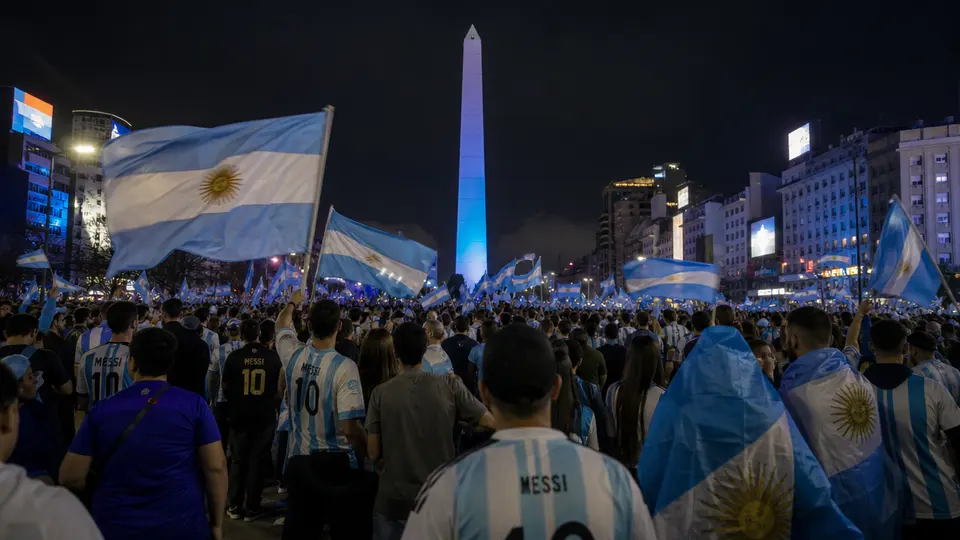
In Buenos Aires, the response was spontaneous and visceral. On one street corner, someone placed a red telephone on a table with a sign reading: "What would you say to Messi?" Passersby picked up the receiver. An 86-year-old man told it: "You will be in my heart until the day I die." A young boy had "burst into tears even though I was at school". A little girl said he was "the best and the greatest". An old man signed off simply: "Bye, son."
Commentators across Argentine cultural and intellectual life joined the chorus. The veteran sportswriter Matías Martin wrote that "Messi led by example", while the coach and motivational speaker Matias Gallo Bevegni reflected that the World Cup winner "taught me more in defeat than in victory". Football pundit Morena Beltrán, struggling to hold back tears, told her colleagues that for her generation Messi's departure carries a sense of mourning that can only be met with gratitude. The psychoanalyst Milagros Filgueras praised the decision to hand-write the note, arguing that some goodbyes require the body's involvement. The journalist Pablo Perantuono devoted his column to the act itself, describing a handwritten letter in the digital age as "almost a countercultural act of originality".
The writer Andrés Burgo placed the moment in its fullest historical frame, observing that in 10 of the past 12 World Cups, either Diego Maradona or Messi had played — a continuous thread of almost 45 years through which grandparents, parents, children and grandchildren had shared an extraordinary privilege. "The heir will arrive," he wrote, "but right now is a time of orphanage. And gratitude."
Turmoil in Argentine football
Messi's departure arrives during a troubled period for the Argentine Football Association, which faces scandals and the external pressure of lobbies seeking to privatise football clubs — currently constituted as non-profit organisations. Several incidents during the 2026 World Cup have resulted in significant fines, sanctions and suspensions. With two upcoming international fixtures scheduled and no opponent yet confirmed, the absence of Messi from the squad will inevitably bear on those arrangements.
It is not the first time he has stepped back. Messi previously announced his retirement from international football in 2016, before returning. This time, the context feels different — not least because of the reference to his father Jorge, whose importance to Messi's relationship with the Argentina shirt has long been evident. The flag that for years seemed to weigh visibly upon him became, in victory, something closer to a cloak of honour; now, his father's death appears, in some measure, to have released him from that burden.
Among the images to emerge from Monday's reaction, one endures: three small boys walking down a Buenos Aires street in Messi number 10 shirts, pointing, as the writer observed, towards a future as yet unknown.
Topics
People
Organizations
Source: The Guardian