Humanoid Robots Beat Bolt's 100m Record at Beijing Games
- Tiangong Ultra completed the 100 metres in 9.39 seconds at the World Humanoid Robot Games in Beijing, beating Usain Bolt's 2009 world record of 9.58 seconds.
- The Honor-developed Lightning robot finished second in the same heat with a time of 9.47 seconds, also faster than Bolt's record.
- Tiangong Ultra additionally ran the 400 metres in 38.16 seconds, undercutting Wayde van Niekerk's 2016 human world record of 43.03 seconds.
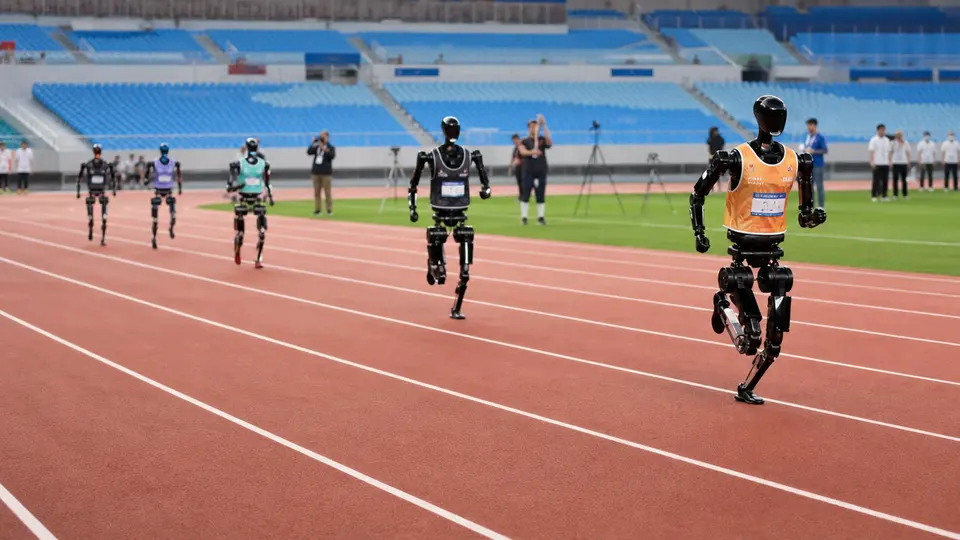
Two Chinese humanoid robots have surpassed Usain Bolt's 9.58-second 100-metre world record at the World Humanoid Robot Games in Beijing, in what organisers are billing as a landmark demonstration of bipedal robot technology.
The headline times
In a preliminary heat on Saturday, Tiangong Ultra — developed by the Beijing Humanoid Robot Innovation Centre — completed the distance in 9.39 seconds. It was followed by Lightning, a robot built by Honor, which crossed the line in 9.47 seconds. Bolt set his 100-metre record in 2009. Tiangong Ultra also ran the 400-metre course in 38.16 seconds, well inside the 43.03-second human world record set by Wayde van Niekerk in 2016. The significance of these performances should be understood in context: they were recorded at a purpose-built competition for robots rather than under the governance of any human athletics body.
The event and its scope
The World Humanoid Robot Games, which launched in 2025, describes itself as an annual showcase for advances in bipedal robot technology. This year's edition features 2,056 robots from 16 countries, competing across categories including sprinting, jumping, football, and boxing. The scale of participation marks a notable expansion for what is still a nascent competition format. For further context on the 9.39-second run, an earlier report examined the Tiangong Ultra's headline time in detail, while a separate account addressed the broader claims around the robot's performance versus Bolt.
After the finish line
The spectacle carries an element of the surreal. Unlike human sprinters, the competing robots do not decelerate gracefully after crossing the finish line. Video footage from the event shows machines colliding with cushioned walls at speed, with organisers collecting the robots — or their components — on stretchers afterwards. The manner in which the robots move to achieve such pace has been described as both striking and unsettling by those who have watched the footage. The broader implication is clear enough: robotic locomotion is advancing at a pace that, in narrow and controlled conditions, can now exceed the outer limits of human athletic performance.