China Reopens Tibet Border Road to Intensify Disaster Search
China fully reopened the only road to the Gyirong border crossing with Nepal on Wednesday, a week after glacial floods destroyed it, enabling heavy machinery to reach the disaster zone for the first time. Search operations are intensifying amid continuing landslide risks.
Written by James Carter
(2h ago)
Developing
What happened?
China fully reopened the road to the Gyirong border crossing with Nepal on Wednesday, one week after a glacial collapse on 26 August destroyed it and triggered widespread flooding and landslides.
Why it matters
The reopening enables heavy machinery and intensive search teams to reach the disaster zone for the first time, as 546 people remain missing in Tibet, including 261 foreigners from 23 countries.
What’s next?
China's confirmed death toll in Tibet stood at 16 as of Sunday, while Nepal's total fatalities from the disaster surpassed 1,000 on Wednesday, according to available figures.
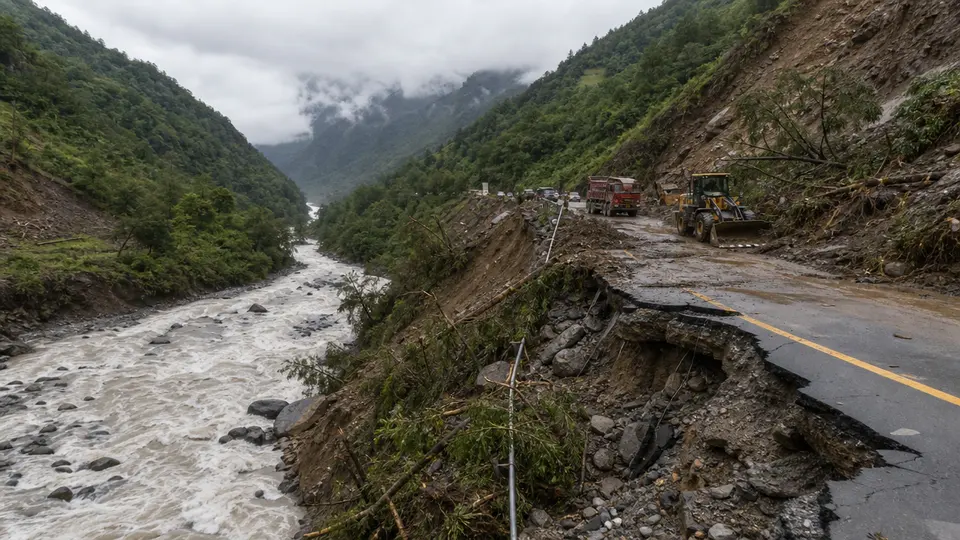
China has fully reopened the sole road linking the Gyirong border crossing with Nepal, exactly one week after catastrophic floods — triggered by a glacial collapse — tore through substantial sections of the route and the river systems on both sides of the border. The reopening, confirmed on Wednesday, allowed heavy machinery to reach the heart of the affected area for the first time since the disaster struck on 26 August.
Rescue teams had worked without pause to reconstruct National Highway G216 after debris flows, set in motion by the glacial collapse, obliterated stretches of the road and caused widespread landslides and flooding. Prior to the road's reinstatement, China had been airlifting equipment and supplies by helicopter to front-line responders, according to state broadcaster CCTV. Soldiers were simultaneously deployed with vital-signs detection equipment to search for those unaccounted for.
Conditions and ongoing risks
Progress was impeded by persistent rainfall and rugged terrain. Teams were required to operate within a narrow mountain gorge hemmed in by unstable slopes and a fast-moving river. Chinese authorities were also monitoring upstream lakes for potential overflow that could trigger further flooding. Officials subsequently indicated that the risk posed by those lakes had diminished, though landslides remained a live concern.
Following the road's reopening, CCTV reported that a large volume of heavy machinery had arrived at the site of what had been the Chinese border inspection complex, alongside additional equipment to reinforce search operations. Multiple rescue teams and excavators are now conducting intensive searches for those still missing. Units equipped with vital-signs detectors and sniffer dogs have been deployed across the most severely affected sections of the border post, riverbanks, ravines, and damaged road segments, according to the broadcaster.
Casualty figures
China reported on Sunday that 546 people remained missing in Tibet, among them 261 foreign nationals from 23 countries, while the confirmed death toll on the Chinese side stood at 16. In Nepal, the total number of deaths from the disaster surpassed 1,000 as of Wednesday.
Topics
Organizations
Places
Source: CNN Brasil