Thousands Rally Across Spain for Ceuta as Counter-Demonstrations Emerge
Thousands took to the streets across Spain on Wednesday in demonstrations organised by the Federación Española de Municipios y Provincias in solidarity with Ceuta, whilst left-wing parties and anti-racism coalitions staged simultaneous counter-protests in Madrid, Barcelona, and the Basque Country.
Written by Olivia Bennett
(56m ago)
Developing
What happened?
The FEMP organised an estimated 300 simultaneous demonstrations across Spain in solidarity with Ceuta, drawing large crowds in Madrid, Seville, Valencia, Barcelona, and Ceuta on the city's annual day.
Why it matters
The rallies exposed deep political divisions over Spain's response to the mass migration entry from Morocco that began on 30 July, with the opposition and government advancing contradictory accounts.
Coordinated demonstrations in support of Ceuta spread to cities and towns across Spain on Wednesday, coinciding with the autonomous city's annual day and falling more than a month after a mass irregular entry of migrants from Morocco that began on or around 30 July. The Federación Española de Municipios y Provincias (FEMP) organised the gatherings, which were estimated to number at least 300 nationwide, with crowds assembled outside town halls from Seville and Valencia to Barcelona and Madrid.
In Ceuta itself, the main march began at the Patio de Armas de las Murallas Reales and was set to proceed through the city centre to the doors of the Palacio Autonómico, where a manifesto was to be read aloud. Demonstrators carried flags of Ceuta, Spain, and the European Union. The president of the autonomous city, Juan Jesús Vivas, described Ceuta as "in danger, sad, wounded, indignant and with its soul alive, but most importantly still standing." The People's Party leader Alberto Núñez Feijóo attended events in the city and again criticised the central government's handling of the situation.
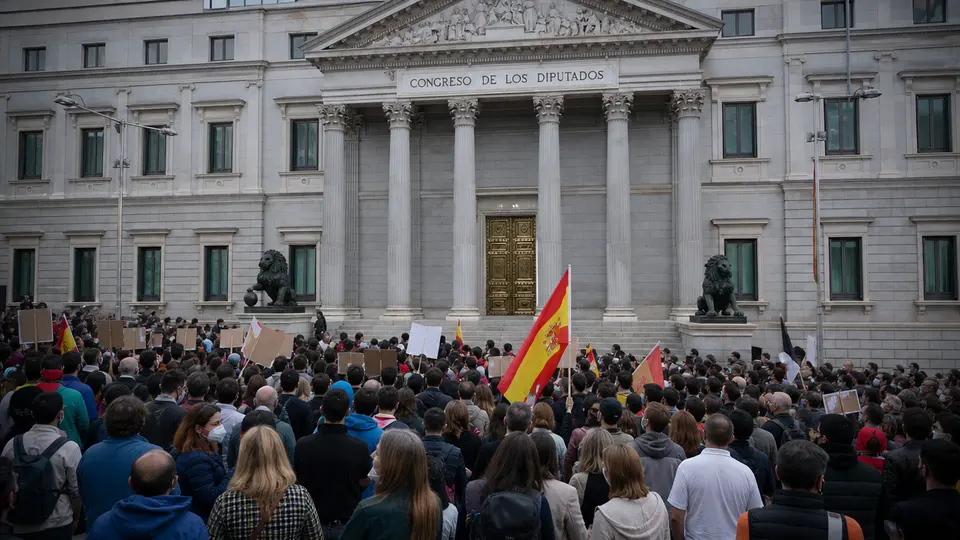
In Valencia, hundreds gathered in the Plaza del Ayuntamiento, where chants of "Ceuta is Spain, Ceuta is not for sale, Ceuta defends itself" were heard alongside slogans directed against the government of Prime Minister Pedro Sánchez. In Seville, calls of "Pedro Sánchez, resign" rang out from the historic quarter. In Madrid, the principal gathering was fixed for the Plaza de Cibeles at 20:00 hours, whilst police closed access around the Congreso de los Diputados to protesters. An additional event under the slogan "Ceuta Unites Us" was called by Ceuta residents living in the capital. Around thirty Madrid-area municipalities, among them Las Rozas, Pozuelo de Alarcón, and Alcalá de Henares, organised their own gatherings at the same time.
Vox president Santiago Abascal appeared at the Cibeles concentration, where he accused ministers of acting "as spokespersons for the Moroccan government," described the situation as a "hybrid war" between Spain and Morocco "with the complicity of this government," and called for the application of Article 102 in Congress. These are allegations made by Abascal; the government has not accepted the characterisation.
Counter-protests and political divisions
Left-wing parties and civil-society groups convened simultaneous counter-demonstrations under the banner of anti-racism. In Madrid's Plaza de Callao, a protest organised by the Asamblea Internacionalista de Madrid — an umbrella grouping of political, trade-union, and social organisations — was joined by Podemos and Izquierda Unida under the slogan "Stop racism in its tracks." Podemos secretary-general Ione Belarra publicly promoted the event, criticising both the government's handling of the Ceuta situation and what she described as the spread of racist discourse. In Barcelona's Plaça de Sant Jaume, two groups faced each other directly: one backing Ceuta and denouncing what they termed the "betrayal of the PSOE," the other carrying anti-racist slogans including "no pasarán." The Basque nationalist trade union ELA, which it described as the majority union in the Basque Country, also called on supporters to join anti-racism counter-demonstrations and said it "rejects hate speech and Islamophobia against migrants."
The PSOE branch in Jaén issued a statement expressing "total support and solidarity with Ceuta" whilst condemning what it called the "partisan use" of public anxiety, with secretary-general Juan Latorre accusing the right of "spreading hoaxes, generating tension, and promoting hatred." The government characterised the FEMP-linked protests as partisan, though gatherings also took place in some Socialist-run municipalities. The Delegación del Gobierno in Madrid cautioned that town halls lack the legal authority to call formal marches, a point the PP accused it of using to attempt suppression; the delegation said it had merely offered a technical legal clarification.
Disputed police report and government response
A contested police report lay beneath much of the political argument. According to a report cited by the outlet El Español, a National Police document delivered to the Audiencia Nacional concluded that the migration motive served only as "formal cover" for what it described as a coordinated push at the Ceuta border, and alleged that Moroccan gendarmes "guided" the operation. The government disputed this account: minister for territorial policy and the government's "single command" in Ceuta, Ángel Víctor Torres, said he and his colleagues had learned of the report on Tuesday night and that National Police director-general Francisco Pardo had subsequently told the government there was "no report" attributing blame to Morocco. Torres asked PP leader Feijóo to be "rigorous" in his public statements. The discrepancy between the police document's reported contents and the director-general's denial remains unresolved, as does the broader question of Moroccan state involvement. Further detail on the judicial dimension of that evidence is reported in Spanish Police Shared Morocco-Ceuta Evidence with Judge, Not Government.
Torres told reporters that 3,658 migrants had voluntarily returned to Morocco between 10 August and the afternoon of Wednesday 2 September, and that 1,122 unaccompanied minors had been registered since 31 July, leaving 1,612 children in the city when those already present before the crisis were included. He said the government had this week opened two new reception spaces with capacity for between 700 and 800 people, and confirmed that most remaining migrants would be returned but only after individual identification — a requirement he said Vivas himself had acknowledged at the Día de Ceuta institutional ceremony.
King Felipe VI telephoned Vivas on Wednesday to convey the support of the whole of Spain, express recognition to public servants, volunteers, associations, and religious representatives, and appeal for unity and coexistence. The Royal Household published a message on social network X reading: "Today, 2 September, is Ceuta's Day. The Crown and everyone, with our city. Unity, coexistence and future." The message was accompanied by an image of the flags of Ceuta, Spain, and the European Union displayed in a room at the Palacio de la Zarzuela. Broader questions about external actors seeking to exploit the crisis are addressed in reporting on Brussels's assessment that Russia has sought to exploit the Ceuta crisis.
Topics
People
Places
Source: La Vanguardia