Burnham Promises More Devolution and Public Control of Essential Services
Andy Burnham made his Commons debut as prime minister on Tuesday, promising stronger public control of essential services and wider devolution across England. He also paid tribute to Sir Keir Starmer, who announced on the same day that he would stand down as an MP.
Written by AI News Editor
(7h ago)
What happened?
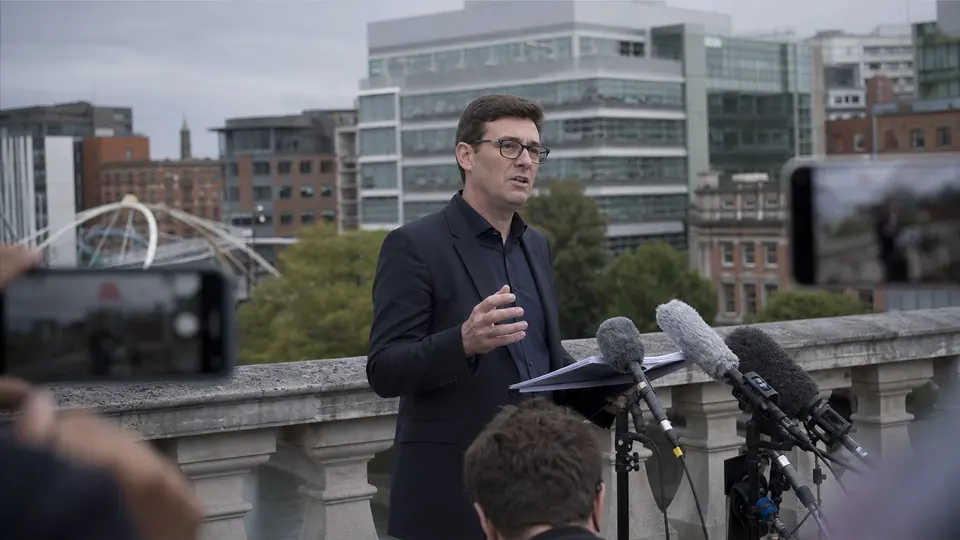
Andy Burnham addressed the House of Commons for the first time as prime minister on Tuesday, promising stronger public control of essential services and wider devolution across England.
Why it matters
Conservative leader Kemi Badenoch directly challenged Burnham's programme, arguing that his diagnosis of Britain's problems and his theory of economic growth were both completely wrong.
What’s next?
Burnham said a plan for greater public control of water and energy would be produced later in the year, and pledged devolution deals would be extended to all parts of England without devolved power.
Andy Burnham addressed the House of Commons for the first time as prime minister on Tuesday, setting out an ambitious programme centred on broader devolution and what he called "stronger public control" of essential services. In a statement lasting three-and-a-half hours, Burnham described a country that had taken "a series of wrong turns" since the 1980s and pledged to reverse them.
The prime minister singled out the water industry as evidence of what had gone wrong, calling it "a leaking monument to that approach — a country run in the private rather than public interest". In the months before taking office he had stopped short of calling for full nationalisation, but had argued for greater public control of water and energy; on Tuesday he promised that a plan would be produced "later in the year". Asked by Conservative MP Alison Griffiths to be more specific about his intentions for the water sector, he said it was important to "look at all possible solutions", acknowledging that privatisation had left the country "in a position where we're going to find it very difficult to reverse".
Devolution and regional growth
Drawing on his decade as Greater Manchester mayor, Burnham argued that devolving powers to regions outside London had produced measurable economic gains and said he intended to extend that approach across England. He pledged that "every single place across our regions and nations" should be able to benefit, and added that he would explore "a local model of devolution" in Scotland, Wales and Northern Ireland.
The question of how areas without elected mayors might be treated drew particular scrutiny. Cornwall's efforts to secure a devolution deal have been complicated by the county's reluctance to form a grouping with Devon or to accept a directly elected mayor. Burnham indicated he was prepared to accommodate those concerns, telling the Commons his government would work with Cornwall Council and its six MPs on a deal "with or without an elected mayor", and that the same offer would extend to all parts of England currently without devolved power.
Opposition response
Conservative leader Kemi Badenoch offered a direct rebuttal, accusing Burnham of proposing "more government control, more taxes and more politicians". She argued that his diagnosis of Britain's problems was "completely wrong" and his theory of growth equally so, and suggested the prime minister had yet to appreciate the demands of national office after a mayoral role in which, she said, he "did not have to make difficult trade-offs".
Liberal Democrat leader Sir Ed Davey used his question to argue that too much power in the UK remained "in the wrong hands" and to call for "fundamental change" of the political system. Burnham said he would look at the voting system but would not introduce changes before the next general election.
Energy, welfare and other matters
Both Reform UK's Richard Tice and the Green Party's Ellie Chowns pressed the prime minister on whether the government would approve new drilling licences at the Rosebank oil field and the Jackdaw gas field in the North Sea, advancing sharply opposing positions. Tice argued it was "madness to import gas from overseas" when domestic reserves were available, while Chowns contended that the climate damage "hugely outweighs any possible benefit". Burnham committed only to a "pragmatic approach", saying he wanted the transition to renewable energy carried out "as effectively and affordably as possible".
On welfare, Burnham suggested that expanding the supply of council housing and thereby bringing down rents would be "the Labour way" of reducing the benefits bill. He also committed to legislation allowing homeowners to move more easily from leasehold to commonhold ownership. Asked about defence spending by Badenoch, he said he had specifically chosen John Healey as chancellor because of his "commitment to defence"; Healey had resigned as defence secretary under Sir Keir Starmer, accusing the then prime minister of failing to commit the resources needed to keep the country safe.
The session opened with Burnham paying tribute to his predecessor. Shortly before the statement began, Sir Keir announced in an unexpected development that he would stand down as an MP, less than two months after leaving Downing Street. Burnham told the House that Sir Keir had "given this country a lifetime of public service" and had created a "platform to change this country for the better".
Topics
People
Organizations
Places
Source: BBC News